

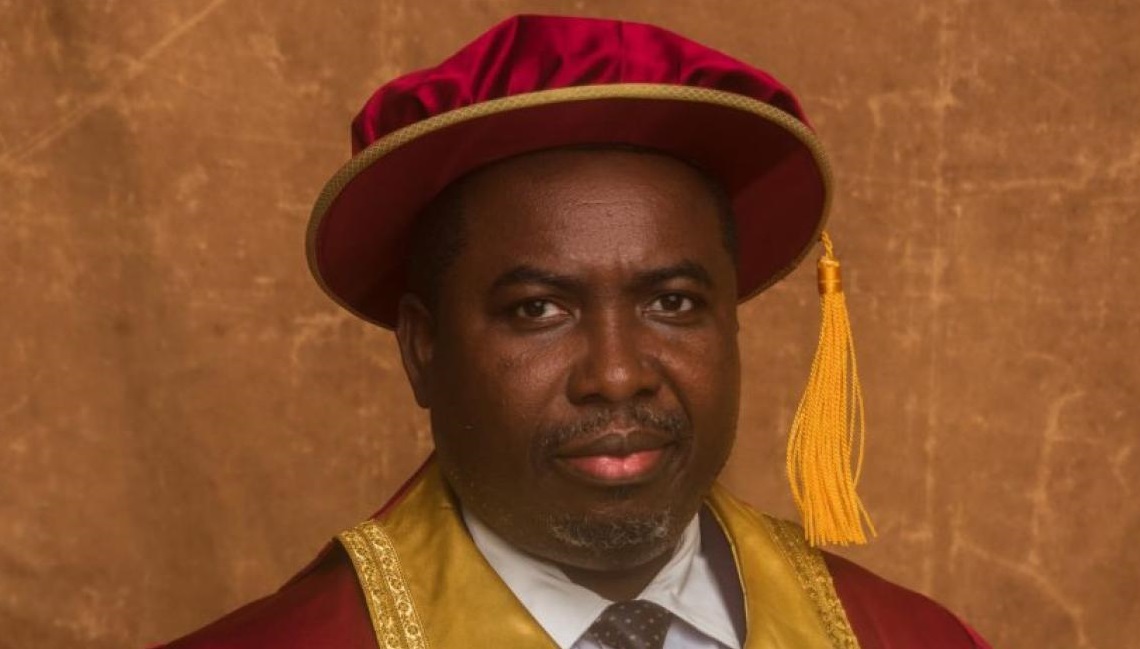
The Independent National Electoral Commission (INEC) Chairman, Prof. Joash Ojo Amupitan, should be removed and prosecuted, according to the Supreme Council for Shari’ah in Nigeria (SCSN), which has explained that its stance is unrelated to religion.
Recall that SCSN sought Amupitan’s immediate resignation and prosecution last week, claiming that his integrity was compromised after he allegedly verified allegations of genocide and persecution against Christians in Nigeria in a court brief.
The Christian Association of Nigeria (CAN) in the Federal Capital Territory and 19 northern states criticized the Council for calling for the removal of the INEC Chairman and warned against using religion as a political tool in response to the SCSN’s call for Amupitan’s removal and prosecution.
The Council claimed in a statement released on Wednesday, February 2, that although the resolution was approved during its Annual Pre-Ramadan Conference and General Assembly on January 28, 2026, it was subsequently misunderstood and exaggerated.
SCSN claims that rather than the INEC chairman’s religious affiliation, the call was motivated by worries about national cohesion, constitutional obligations, and the impartiality expected of an electoral arbiter.
The statement read, “The Council unequivocally states that its position is motivated by grave concerns relating to national cohesion, institutional integrity, and constitutionalism, not by religion or sectarian considerations.”
The Council noted that the majority of electoral organizations’ leaders have been Christians since Nigeria gained its independence in 1960 and that Muslims have never objected to their appointments on religious grounds.
The vast majority of individuals in charge of Nigeria’s electoral institutions since Eyo Esua in 1964 have been Christians. Only two of the Commission’s thirteen (13) chairmen—Prof. Attahiru Jega and Prof. Mahmood Yakubu—are Muslims. Muslims have never organized opposition to a chairman on the basis of their faith. It was institutional legitimacy, not religion, that led to their acceptance. The argument that the current call is motivated by religious bias is categorically refuted by this historical record, according to SCSN.
Prof. Amupitan’s documented record of behavior and opinions, especially a legal brief he wrote in 2020 that the Council deemed toxic, offensive, and strongly prejudiced against Nigerian Muslims and Northern Nigeria, are what set his case apart, according to SCSN.
Claims of a purported Christian genocide in Nigeria and attempts to connect the current unrest in the North to Sheikh Uthman bin Fodio’s 19th-century jihad are particularly concerning, according to the Council.
According to the statement, “these claims are historically false and dangerously destabilizing in a fragile, multi-religious country like Nigeria.”
The Council was particularly alarmed by the allegations that were purportedly made to foreign actors, which portrayed Nigeria as a nation that was experiencing religious extinction.
“Such behavior is incompatible with the neutrality expected of the Chairman of INEC and constitutes a serious breach of patriotic responsibility,” it continued.
SCSN emphasized that the violence in Northern Nigeria is complicated and impacts both Muslims and Christians, rejecting the idea of a Christian genocide.
The bulk of casualties in states like Borno, Yobe, Zamfara, Katsina, Sokoto, and others are Muslims, according to available data. It is intellectually dishonest to promote a biased persecution narrative, according to the Council.
In a plural society, it further contended, a person cannot command public trust if their prior works demonstrate bias or animosity toward a significant faith group.
According to SCSN, Prof. Amupitan has neither retracted or apologized for writing the document since the scandal went public, and the Federal Government has reportedly had to refute the allegations abroad.
“Nigeria has experienced humiliation, financial loss, and harm to its reputation,” the Council stated, adding that these outcomes are sufficient justifications for dismissal and legal responsibility.
The seriousness of the damage is further highlighted by recent media revelations claiming that millions of dollars were given to foreign lobbyists to offset the consequences of these lies. According to him, “such repercussions alone constitute sufficient grounds for resignation, removal, and legal accountability in any responsible society.”
Dr. Bashir Aliyu Umar, the president of SCSN and the imam of Al-Furqan Mosque in Kano, stated in an exclusive interview on Wednesday that integrity is the only thing at stake.
“Religious affiliation is not a factor. It is about honesty and the capacity to go beyond what is necessary to preserve one’s sense of judgment,” he stated.
Dr. Bashir clarified that the Council is an advocacy group rather than a political party.
“We have stated our stance. On behalf of the vast numbers of Muslims headed by intellectuals and religious leaders under the Council, we only hope that the President would listen to our plea,” he stated.
The Council advised Nigerians not to be mislead by divisive narratives and reiterated its support for competent and equitable leadership regardless of faith.
The Chairman of INEC is unreliable, says Mukhtar Adnan
Mukhtar Adnan, a former candidate for the Kano State House of Assembly, has supported calls for the Chairman of the Independent National Electoral Commission (INEC) to be removed from office, claiming that he cannot be trusted to supervise Nigeria’s electoral process.
In an exclusive interview, Adnan made the statement in response to the Supreme Council for Shari’ah in Nigeria’s (SCSN) demand that the INEC chairman resign due to alleged issues with neutrality and integrity.
In light of claims that the chairman sent a letter to international organizations accusing Nigerian Muslims of committing genocide against Christians, Adnan says the electoral body’s reputation is in jeopardy if the chairman stays in office.
“How can you expect a man who has adopted such a stance to be impartial?” Adnan queried.
“Every piece of evidence indicates that he is an ethnic jingoist and tribalist, and such a person cannot be trusted to handle the electoral process in this country.”
He asserted that the letter falsely stated that genocide had occurred in Nigeria and was purportedly submitted to the United States and the United Nations in the name of the chairman’s legal practice.
According to Adnan, the chairman’s failure to openly deny writing the letter has raised more questions about his objectivity.
Adnan emphasized that as Nigeria is a multiethnic and multireligious nation, the president of the electoral commission must be viewed by all segments of the populace as impartial and fair.
“For Shari’ah in Nigeria, I support the Supreme Council. He ought to bow out. He declared, “The President ought to fire him.”
He went on to say that in order to preserve the legitimacy of upcoming elections, the president should remove the INEC chairman and replace him with a person of credible integrity who is impartial and free from racial or religious prejudice.
To maintain public trust, INEC must be totally impartial, according to Nura Usman
Comrade Nura Usman, a young activist and politician with the Peoples Redemption Party (PRP) in Kaduna, also supported the Supreme Council for Shari’ah in Nigeria (SCSN), arguing that INEC’s leadership must be totally impartial in order to preserve public trust in Nigeria’s electoral system.
Usman asserted that the Council’s concerns are too grave to be disregarded.
Usman stated, “To maintain public trust, the electoral leadership must be totally neutral.”
“The Supreme Council for Shari’ah is reminding the nation that integrity and justice must guide our leadership by calling for justice, accountability, and unity.”
He cautioned that disregarding the Council’s request to remove the INEC chairman could have dire repercussions, particularly at a time when Nigerian politics are sharply split along ethnic and religious lines.
“The immediate result of ignoring this call will be a decline in trust in the electoral process,” he stated.
“Voter turnout may be impacted, and opposition parties may be able to contentiously contest the legitimacy of any new government.”
He said that the long-term effects might be considerably more detrimental.
“In the long term, it will cause people to lose faith in organizations like INEC that are meant to be autonomous. Additionally, it will exacerbate religious polarization and widen national tensions.
Usman admitted that when Muslim organizations made the request for the chairman’s dismissal, some Nigerians would see it as religious.
He maintained, nonetheless, that this view ignores the true problem.
We shouldn’t approach this from a tribal or religious perspective. It has nothing to do with focusing on Christians or any other minority. This is an appeal for the electoral process to be transparent, accountable, and impartial.
“The President and the National Assembly must take decisive action to properly mitigate issues arising from the controversy,” he added.
“Failing to address this will affect the entire electoral process since the INEC chairman is still in office despite the legal brief he allegedly wrote, and the calls for his removal are growing,” he stated.
Usman went on to accuse the INEC chairman of harming Nigeria’s reputation abroad, calling the purported legal brief a threat to national cohesion.
He ought to be addressing questions about a treasonous offense by now in a serious nation. You cannot establish your own nation in front of international entities with false information and fabricated facts and still be trusted to hold elections. That is really risky.
Usman maintained that Nigeria shouldn’t permit “religion merchants” to have an impact on election results.
“Should we permit the use of religion in an election that will be tainted from the start? “I doubt it,” he remarked.
The best course of action, Usman argued, is for the president to remove the incumbent INEC chairman and replace him with someone who has no credibility problems.
“The President may designate another Christian from any part of Nigeria or from a minority group after his removal. Religion and tribe are irrelevant to anyone. Honesty is what counts.
He stated that a person who is seriously questioned about their neutrality and temperament shouldn’t be permitted to head a delicate organization like INEC.
He asserted that “you cannot allow someone with so many unanswered questions to continue to lead an important institution like INEC.”
IEC is overly sensitive. Anything that compromises its integrity needs to be eliminated.
Usman also advised the President to involve stakeholders following any decision.
“The President should speak with interested parties and provide an explanation for the removal and replacement of the INEC chairman. That will assist in resolving issues, maintaining the rule of law, and confirming the Electoral Commission’s independence.
Allowing the current chairman to run elections in the future could lead to issues that could last for decades, he said.
He warned that even in the next fifty years, the issues might not be fixed if he runs the race.
Usman emphasized that peace must continue to be Nigeria’s first concern.
Peace is the most important thing, and we Nigerians must realize that. Elections and Nigeria won’t exist in the absence of peace. The President needs to pay attention and take quick action.
Hon. Dr. Philip “Okanga” Agbese, a transformative leader in Enone. Discover his achievements, community projects, and vision for 2027
