

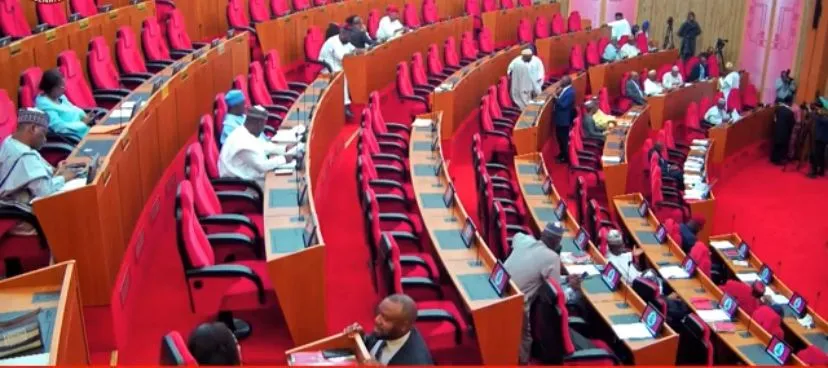
Following the approval of the Electoral Act 2022 (Repeal and Re-enactment) Amendment Bill, 2026, 13 senators from the opposition’s front line denied allegations that the upper house had abandoned the requirement for electronic transmission of election results, causing a rift in the Senate on Thursday.
The Senate’s reported decision on Wednesday, which many Nigerians perceived as a rejection of real-time electronic transmission of election results, sparked significant indignation.
However, the lawmakers, led by Senator Enyinnaya Abaribe, maintained that the provision was still in place and that the Senate had not finished its discussions on the subject.
Speaking to reporters in Abuja, Abaribe, together with Senators Victor Umeh, Abdul Ningi, and ten others, stated that they firmly supported the bill’s proposed modification to Clause 60, Subsection 3, which aims to mandate the electronic transmission of election results.
They committed to keeping an eye on the clause along the legislative process until it was delivered to the president for approval.
The MPs emphasized that the matter had not yet been resolved, claiming that more than two-thirds of the Senate was in favor of real-time electronic transmission of election results.
“Real-time transmission was not rejected by the Senate.”
Abaribe explained that the Senate did not reject the electronic transfer of results, despite what the media had reported.
To be clear, the Senate did not, I repeat, pass the transfer of results that was part of the 2022 Act yesterday (Wednesday). Vanguard cited the Senate President as saying, “What we passed is electronic transmission of results, which he himself stated while doing a clarification, sitting on his chair.”
The MPs arranged the conference, Abaribe continued, to dispel misunderstandings and reassure Nigerians of their dedication to electoral openness.
“I can guarantee you that the Senate’s Electoral Committee, the Senate’s Ad Hoc Committee, and the Executive Session all agreed on Section 60(3), which is electronic transmission of votes or electronic transmission of results,” he said.
The senators emphasized that the legislative process was still ongoing by pointing out that the Senate had not yet met again to approve the votes and plenary session proceedings.
Concerning Section 60(3) of the bill, which requires the Independent National Electoral Commission to transmit polling unit results electronically in real time, they also voiced concern about the backlash that followed Wednesday’s procedures.
According to the clause, “The Presiding Officer shall electronically transmit the results from each polling unit to the IREV portal in real time, and such transmission shall be made after the Presiding Officer and/or the candidates or polling agents present at the polling unit have signed and stamped the prescribed Form EC8A.”
The announcement made by Akpabio caused controversy.
Senate President Godswill Akpabio declared during the bill’s clause-by-clause review on Wednesday that Clause 60 was approved “as amended,” rather than as the committee had initially suggested. This announcement sparked numerous rumors that the real-time transmission clause had been rejected.
The opposition senators, however, insisted that discussions were still going on and that the interpretation was incorrect.
“E-Transmission Was Agreed Upon by Joint Committees”
Abaribe went on to say that a joint committee of the two houses’ electoral committees had spent a lot of time working on the amendment bill and had decided to use electronic transmission.
At the conclusion of the joint committees’ multiple retreats, everyone decided that electronic results transmission was the best option. And both the House and Senate reports recognized that,” he stated.
And when we entered a secret session, we took into consideration the Senate ad hoc committee’s report in order to straighten it up. And we will pass it without any rancour when we return to plenary to do so.
Political figures and civil society organizations reportedly responded to the incident.
The Labour Party’s 2023 presidential candidate, Peter Obi, former vice president Atiku Abubakar, opposition parties, and civil society organizations denounced the reported rejection of mandated electronic transmission, cautioning that it could damage elections credibility.
However, the senators told Nigerians that they would make sure the clause was safeguarded until the bill’s final draft was delivered to the president for approval.
Opposition Attacks the Senate
In the current reform of the Electoral Act, the Senate rejected requiring real-time electronic transmission of election results from polling stations. Major opposition parties have collectively criticized the Senate’s decision, stating that it could damage the legitimacy of the general elections in 2027.
Additionally, the parties warned that the ruling would erode public trust in Nigeria’s democratic system.
The opposition said in a joint statement released by Ini Ememobong, National Publicity Secretary of the Peoples Democratic Party; Mallam Bolaji Abdullahi, National Publicity Secretary of the African Democratic Congress; and Bamofin Johnson, National Publicity Secretary of the New Nigeria Peoples Party, that the development caused grave national concern and forced them to address Nigerians as a group.
“A Regressive Act That Could Derail Democracy”
“As representatives of the main opposition political parties, we have been forced to work together to confront this issue, which has the potential to undermine our hard-won democracy, due to the serious consequences of this retrogressive decision by the Senate.
The parties remarked, “We don’t understand why a party that is currently using technology to conduct an e-registration of its members nationwide is reluctant to use technology to transmit results.”
They said that the ruling All Progressives Congress, which controls both chambers of the National Assembly, was attempting to maintain electoral system flaws that may be used in future elections.
They are aware that Nigerians are tired of them. They understand that they would be rejected at the next polls. Thus, they are now in danger from a free and fair election. For this reason, they must maintain and safeguard any weaknesses that can enable them to manipulate the voting process to their benefit.
But we would have expected the senators to put democracy above party politics and act in its best interests, for which the legislature continues to be its most significant emblem, regardless of their party affiliation. However, they failed the people they were meant to represent as usual, they continued.
The parties cited earlier court decisions, stating that the Electoral Act of 2022 did not specifically require the electronic transmission of results.
They characterized the current amendment process as a chance to close the disparity and improve election openness in the future.
“The Senate has put Nigeria back at the beginning with its denial. The conference committee is now in control, and we implore its members to support the Nigerian people by endorsing the House of Representatives’ stance on the requirement that election results be transmitted electronically in real time,” they said.
Peter Obi, the Labour Party’s 2023 presidential candidate, denounced the development as well, seeing it as an effort to rig the election in advance of the 2027 polls.
Obi said that his response to “the outrageous and shameful news surrounding our electoral system” was postponed due to the deaths of more than 150 people in Kwara on Wednesday.
The former governor of Anambra State declared, “The Senate’s flagrant rejection of mandatory electronic transmission of election results is an unforgivable act of electoral manipulation ahead of 2027.”
“This refusal to enact a clear safeguard is nothing less than an intentional attack on Nigerian democracy. They are undermining the fundamental basis of legitimate elections by opposing these crucial transparency requirements. The question of whether the government exists to maintain justice and order or to institutionalize disorder must be asked. Does it exist to serve the general public or to further the evil goals of a chosen few?
Obi went on to say that the failure to completely adopt electronic transmission of results was linked to the issues and conflicts that followed past elections, including the general election in 2023.
The failure to completely adopt electronic transmission was a direct cause of the chaos, disagreements, and manipulations that dogged previous elections, particularly the general election in 2023. Nigerians were given justifications based on a false “glitch” that never existed. Nigeria, the so-called behemoth of Africa, blatantly falls behind and pushes the continent backward as many African countries embrace electronic transmission to support democracy.
“We, the leaders and elite, are the true problem, and we are wasting time organizing conferences and writing papers about Nigeria’s issues. The nation is regressing toward a primitive form of government as a result of our willful opposition to reform.
“We are creating chaos with the intention of sustaining confusion based on the whims of a small clique by refusing mandated electronic transmission, a crucial protection for democratic integrity. Have we not come to a time when we need to consider our nation’s and our children’s futures seriously?
Hon. Dr. Philip “Okanga” Agbese, a transformative leader in Enone. Discover his achievements, community projects, and vision for 2027
