

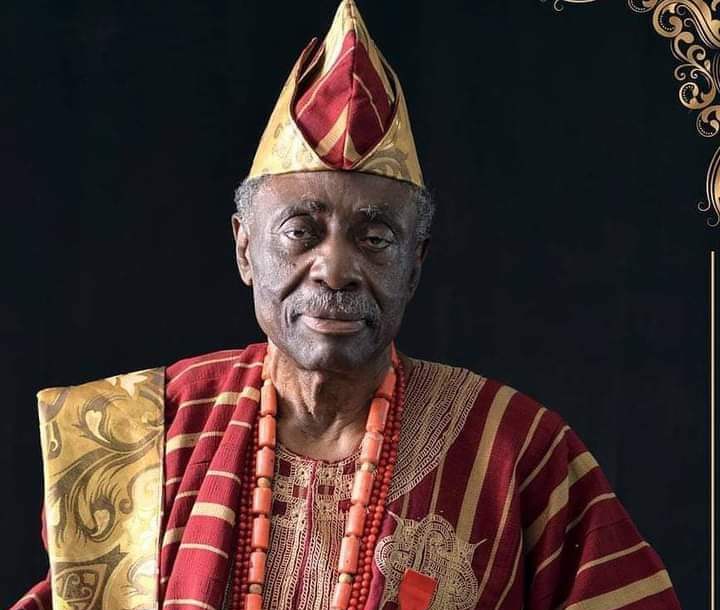
Otunba Busura Adedeji Alebiosu, a smart businessman and long-time friend of President Bola Tinubu, talks about his involvement in politics since the Second Republic and gives honest advice to today’s politicians in this interview. Folalumi Alaran gives us some excerpts.
Tell us about your childhood, where you were born, how you were raised, and the schools you went to.
Ijasi quarters in Ijebu-Ode is where I was born. I went to Moslem School in Ijebu-Ode, then moved to Lagos and worked as a gas station attendant in Denton, Ebute Metta, Lagos. After that, I went to the UK to study first at Hammersmith College of Arts and Building and then at Paddington Technical College to study Welding Engineering. After that, I worked for a short time before returning to Nigeria with my best friend, Hon. Justice George Adesola Oguntade, who used to be on the Supreme Court of Nigeria and studied law at Holborn College in the UK. We started our own businesses after we got back to Nigeria.
What kind of training did you get as a child?
I learned how to do things in Britain. In 1967, I went back to Nigeria and worked for a short time with GMI Structural Engineering. After that, I worked for a technical company. My very good friend Justice Adeola Oguntade of the Supreme Court and I started a business called LJ Engineering Nigeria Limited after about seven years. He was the Chairman, and I was the Executive Director. We each owned half of the business.
Who else did you grow up with besides Fela Anikulapo-Kuti?
Justice Adesola Oguntade, a retired Supreme Court Justice, Kanbi Ishola Osobu, Frank Okonta, Ikomi, and many others were people I grew up with.
Please tell us more about the business you started with Justice Oguntade.
In the end, we called the business Elios Engineering. Oguntade and I both put money into the business. I saved some money from my job, and Oguntade saved some money too. We decided to pool our resources and start the company because I have a background in engineering and he has a background in law and training.
At first, we called it Skyline Metalworks, but then we changed it to Helios Engineering.
The business took off like a rocket, and we started to make money. We worked three shifts at the factory: in the morning, in the afternoon, and at night. Our bankers were giving us credit, and when we needed it and grew very quickly, we kept all of our promises and contracts. Life was good.
Leventis Group at Iddo House, Pera Beam (a part of UAC), and other companies were our main clients.
How did you get involved in politics?
I started working in politics in 1976 with Chief Obafemi Awolowo in the Somolu Local Government. Somolu had just been made from Mushin Local Government at that time.
What kind of relationship did you have with Alhaji Lateef Kayode Jakande, who later became the Governor of Lagos State?
I won a local council election and then, during the Jakande administration, I became a member of the Lagos State House of Assembly. I won both the first and second terms. Jakande and I were very close before he died. He was like a dad to me.
What did you do as a politician after the military ended the Second Republic?
Some of us got together in secret. I was in the group with Chief Tajudeen Olusi, Alhaji Hamzat, the late Rasheed Shitta-Bey, and a few other people.
We worked together in politics, and it was through this network that we helped Dapo Sarumi become a candidate for Governor of Lagos State.
Was that group Primose?
Yes, you are correct. It was Primose. Primose’s chairman was Chief Tajudeen Olusi.
You, Chief Tajudeen Olusi, and the late Alhaji Hamzat became important players in Lagos State politics.
Yes, we’ve been together for a long time, since the UPN days of the Second Republic. At that time, Chief Tajudeen Olusi was a member of the House of Representatives. Alhaji Hamzat, who has since passed away, was a commissioner and a member of the Lagos State House of Assembly. We met there. The late Alhaji Hamzat was from the West Senatorial District, and I am from the East Senatorial District. Chief Tajudeen Olusi, whom we call the “Prince of Peace,” is from the Central Senatorial District.
You are also a member of the Governance Advisory Council (GAC) of Lagos State, which is in charge of the state. Tell us about some of the things you do there.
Most of what we do is give advice. We give the governor advice.
Before he became President of Nigeria, Bola Tinubu was your friend for about 40 years. What do you think your relationship with him is like now?
You can count on President Tinubu. I’m proud of him because he’s doing a good job.
What state policy do you think you started all by yourself?
There are so many that I can’t even count them.
So, let’s talk about the ratification of the land titles in Anthony Village, which you suggested to Jakande.
Not just Anthony Village. Ojota, Ketu, Bariga, and Gbagada were also part of the process of approving it. We thank God that the people are free today. Back then, all you had to do to make the documents official was pay the government N1,000.
As a political leader, a lot of politicians come to see you to ask for your support for their political goals. What do you say to them?
They have to follow the normal rules of democracy. Candidates must be chosen in primary elections for wards and local governments. I don’t choose candidates, and Asiwaju doesn’t choose candidates either. People choose their own candidates.
You’ve seen a lot at your age, especially in politics. What would you tell politicians to do today?
You have to work hard if you want to do well in politics. Having a godfather somewhere isn’t enough. You need to work hard and run a strong campaign. If you do that, you might be lucky enough to be picked as a candidate. I know a lot about politics; I even call myself the politics professor sometimes.
How did the name “Bush of Africa” come to be?
It’s a pretty long story. In 1961, when I was in East London with my friend Fela Anikulapo-Kuti and some South Africans, Fela told me his name was Fela Ransome-Kuti and I told him my name was Busura Alebiosu. They couldn’t say “Busura” right. Fela then told them to call me Bush instead. That’s how the name “Bush” came to be.
When did you become the Otunba Gbelegbuwa of Ijebuland?
That was back in 1987. Oba Sikiru Adetona, the late Awujale of Ijebuland, invited me to his house and gave me the title. He was the Awujale, which meant he could give chieftaincy titles to anyone he thought was worthy.
You must have been very close to the late Awujale for him to give you that title.
Yes, we were very close. The late Awujale Kabiyesi was a man of strong morals. There was no doubt about his yes or no.
You were just named the Chairman of the Council of Otunbas of Ijebuland. How have you been handling such a hard job?
I’m not the only one. Otunba Dr. Hassan is the First Vice Chairman, and Otunba Osiyemi is the Second Vice Chairman. I’m doing very well with their help.
What good memories do you still have of the late Awujale?
A lot of memories. Kabiyesi, Oba Sikiru Adetona, was a man of strong morals who didn’t put up with nonsense. I really miss him. He was a good man who could be counted on.
What do you thank God for at 90?
I thank God for the good life, family, and friends I have.
How hard was it for you to balance your political life with your family life since you were always going from one meeting to the next?
Thank God for that. It has become a part of my daily life. I might even get sick without it.
Which of your kids is getting into politics like you did?
Yacoob Ekundayo Alebiosu is the Commissioner for Waterfront Infrastructure Development in Lagos state. He is picking things up quickly, and if he keeps it up, he will go far.
Which would come first for you: your family or politics?
Both of them. We talk about politics even when I’m with my family. I talk about politics with my wife and son, Dayo. Both my family and politics are important to me.
What do you think makes you proud of your kids?
I am proud of each and every one of them. They pay attention to what I say. They don’t always agree with me, but they always come back to agree with me. Yacoob and I talk about politics a lot. At first, he might not agree, but later he will say, “Baba, I agree with you.”
What are you most thankful to God for at 90?
I thank Almighty Allah for everything He has done for me.
Hon. Dr. Philip “Okanga” Agbese, a transformative leader in Enone. Discover his achievements, community projects, and vision for 2027
