

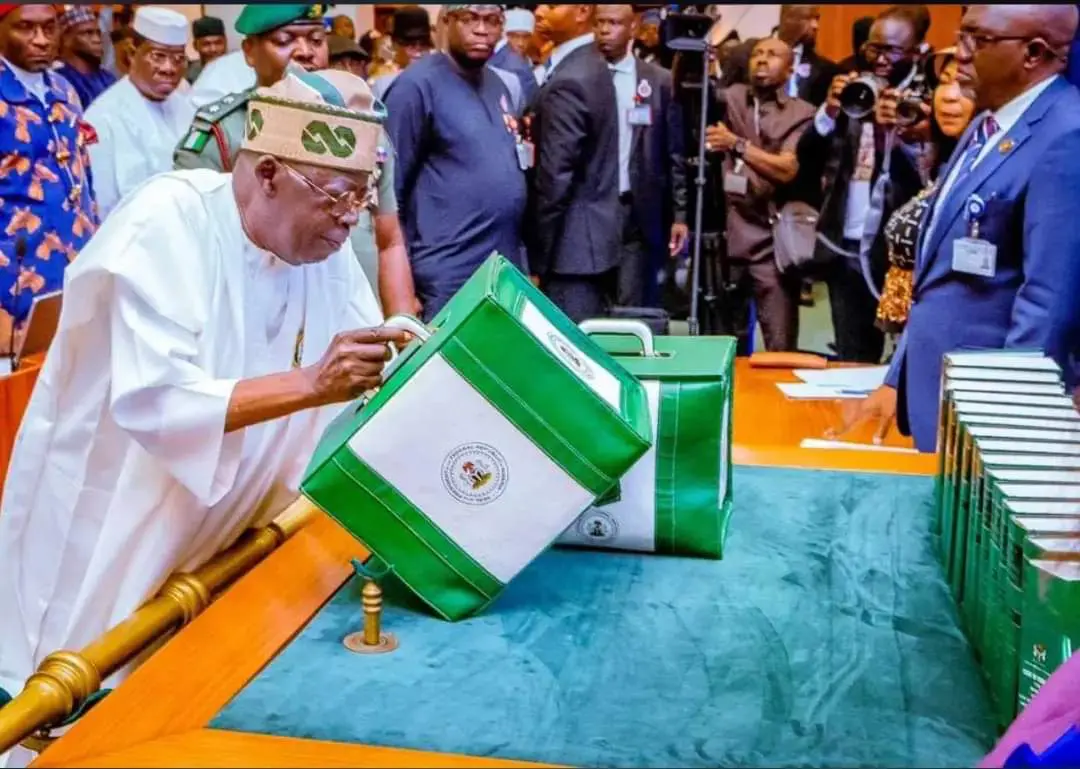
A joint session of the National Assembly was presented with the 2026 Appropriations Bill by President Bola Tinubu on Thursday. The bill proposes a total budget of N58.46 trillion, with an estimated N15.25 trillion going toward non-debt recurrent expenditures.
In his address, the President fixed capital expenditure at N26.08 trillion and established the crude oil price benchmark for the fiscal year at US$64.85 per barrel.
The President’s address is available in full here, along with a summary of the 2026 budget.
Methods
Honorable President of the Senate,
Respected Speaker and Members of the House of Representatives,
Honorable National Assembly Members and Distinguished Senators,
Dear Nigerians,
1. In accordance with my constitutional obligation, I stand before this Joint Session of the National Assembly to propose the Federal Republic of Nigeria’s 2026 Appropriations Bill.
2. This is a pivotal point in the reform and change of our country. We have made a conscious decision over the past 2.5 years to address long-standing structural flaws, stabilize our economy, restore trust, and provide a solid basis for a more resilient, inclusive, and dynamic Nigeria.
3. These changes have not been easy, but they were required. Budget execution has been put to the test, established procedures have been upset, and families and businesses have been under strain. I tell Nigerians that their sacrifices are not in vain and I openly acknowledge these challenges. Although reform is rarely easy, it is the most reliable path to long-term stability and prosperity for all.
4. We present a budget today that builds on our achievements, fortifies our resilience, and transforms recovery into higher living standards for all Nigerian households.
THE 2026 BUDGET’S THEME
5. “Budget of Consolidation, Renewed Resilience and Shared Prosperity” is the subject of the 2026 budget. It demonstrates our commitment to securing macroeconomic stability, enhancing competitiveness, and guaranteeing that growth results in respectable employment, growing wages, and an improved standard of living throughout our Federation.
ECONOMIC REALITIES: STABILISATION SIGNS AND THE GOAL OF THE NEXT STEP
6. The 2026 Budget was created in light of an improving global outlook, Mr. Chairman of this Joint Sitting. However, Nigeria continues to be our primary focus: creating a robust economy that benefits our citizens.
7. The fact that our reform initiatives are already producing quantifiable outcomes gives me hope:
In Q3 2025, our economy expanded by 3.98%, surpassing the 3.86% growth in Q3 2024.
Eight consecutive months have seen a decrease in inflation, with headline inflation falling from 24.23% in March 2025 to 14.45% in November 2025. With stabilizing food and energy prices, tighter monetary conditions, and improving supply responses, we expect the disinflationary trend to persist—so that inflation continues to decrease further over the 2026 horizon, barring major supply shocks.
Thanks to sector changes, increased security, and the use of technology, oil production has increased.
Better tax administration, not excessive taxing, has led to a considerable increase in non-oil revenues.
Capital inflows, fresh project finance, and increased private sector involvement are all signs of the recovery of investor confidence.
As of November 14, 2025, our external reserves had increased to a seven-year high of around US$47 billion, offering more than ten months of import coverage and a more robust buffer against shocks.
8. These results are not coincidental. They represent challenging but thoughtful policy decisions. Consolidating these advantages is now our duty, so that prosperity becomes shared prosperity and stability becomes prosperity.
2025 BUDGET PERFORMANCE: EXECUTION, ACCOUNTABILITY, AND LESSONS
9. Distinguished Members, we had to deal with the realities of transition and conflicting execution needs when implementing our 2025 budget. As of Q3 2025, we noted:
revenue of N18.6 trillion, or 61% of our goal; and
Spending N24.66 trillion, or 60% of our goal.
10. As of June 2025, N2.23 trillion has been released for the execution of 2024 capital projects after the 2024 capital budget execution was extended until December 2025.
11. Despite ongoing financial difficulties, the government fulfilled its primary responsibilities. However, as of Q3, only N3.10 trillion—roughly 17.7% of the 2025 capital budget—was disclosed, indicating the focus on finishing critical 2024 capital projects during the transition period.
12. To be clear, budget execution will be more disciplined in 2026. To ensure that the 2026 Budget is implemented strictly in accordance with the appropriated details and timelines, I have issued directives to the Honourable Minister of Finance and Coordinating Minister of the Economy, the Honourable Minister of Budget and Economic Planning, the Accountant-General of the Federation, and the Director-General of the Federation’s Budget Office.
13. With the new National Tax Acts and the ongoing changes in the oil and gas industry, we anticipate better revenue performance. These reforms are intended to promote openness, efficiency, fairness, and long-term value in our fiscal architecture in addition to raising income.
14. Regarding Government-Owned Enterprises, I will also be clear. All GOE heads are hereby instructed to fulfill their designated revenue goals. In order to ensure that leakages are sealed, compliance is verifiable, and remittances are timely, we will implement end-to-end digitization of revenue mobilization, including standardized e-collections, interoperable payment rails, automated reconciliation, data-driven risk profiling, and real-time performance dashboards. These goals will serve as essential elements of institutional scorecards and performance reviews. Nigeria can no longer afford strategic agency underperformance, inefficiencies, or leaks. Each institution has a role to play.
The 2026 Budget’s Philosophy and Goals
15. Four distinct goals serve as the foundation for the 2026 Budget, Mr. Chairman and fellow Nigerians:
First, maintain macroeconomic stability;
2. enhance the climate for investment and enterprise;
Three, encourage growth that is rich in jobs and lessen poverty; and
Four, protect the weak while enhancing human capital.
16. To put it succinctly, we will pursue growth that is sustainable rather than transient, broad-based rather than narrow, and manage debt with discipline.
Overview of the 2026 Budget: The Financial Framework
17. Honorable Members, the Federal Budget for 2026 is based on growth, moderation, and realism.
18. The following are the main aggregates:
N34.33 trillion is the anticipated total revenue.
N58.18 trillion is the estimated total expenditure, which includes N15.52 trillion for debt servicing.
N15.25 trillion in recurring (non-debt) expenses.
N26.08 trillion was spent on capital.
N23.85 trillion, or 4.28% of GDP, is the budget deficit.
19. These figures go beyond simple accounting lines. They serve as a declaration of the country’s priorities. Value-for-money expenditure, debt transparency, and fiscal sustainability continue to be our top priorities.
20. This budget’s parameters are established by the 2026–2028 Medium-Term Expenditure Framework and Fiscal Strategy Paper. Our estimates are predicated on:
a cautious benchmark of US$64.85 per barrel for crude oil;
1.84 million barrels of crude oil are produced daily; and
a ₦1,400 US dollar exchange rate for the fiscal year 2026.
21. We will keep cutting waste, tightening regulations, and making sure that every naira borrowed or spent produces quantifiable public benefit, particularly in the areas of infrastructure, human capital, and security.
PRIORITIES AND ALLOCATIONS: PRODUCTIVITY, PEOPLE, AND SECURITY
22. The Renewed Hope Agenda and Nigerians’ practical needs are reflected in our allocations. Important sectoral provisions consist of:
Security and Defense: N5.41 trillion
N3.56 trillion for infrastructure
N3.52 trillion for education
N2.48 trillion for health
23. There are connections between these priorities. Investments won’t prosper without security. Productivity won’t increase in the absence of healthy and educated citizens. Jobs and businesses cannot grow without infrastructure. For this reason, the Budget is structured as a single, cohesive national rejuvenation program.
24. Security continues to be the cornerstone of progress. The 2026 Budget increases backing for:
modernization of the military;
cooperative operations and intelligence-driven policing;
border security and monitoring made possible by technology; and
community-based conflict avoidance and peacebuilding.
25. Since security spending must produce security results, we shall invest in security with clear accountability for results. Increasing the fighting capacity of our military forces and other security agencies by hiring more people and acquiring state-of-the-art platforms and other gear will continue to be our top priority in order to safeguard our nation. In order to eradicate terrorism, banditry, abduction for ransom, and other violent crimes, we are also seeking a new age of the criminal justice system. The national security infrastructure is being reset by our government, and a new national counterterrorism doctrine is being established. This comprehensive redesign is based on unified command, intelligence, community stability, and counter-insurgency. The way we deal with terrorism and other violent crimes, which have become existential dangers to our corporate survival and have increased public fear, will be drastically altered by this new philosophy.
Any armed group or gun-wielding non-state actors operating outside of state authority will be considered terrorists going forward under this new architecture. Bandits, militias, armed gangs, armed criminal networks, armed robbers, violent cult organizations, armed collectives headquartered in forests, and mercenaries with ties to other countries are some of these. Terrorists also include organizations or individuals that use violence to further political, ethnic, economical, or sectarian goals. Terrorists are defined as members of any group that extorts communities, kidnaps civilians, or occupies or attempts to occupy territory within Nigeria. The commonality is that you are considered a terrorist if you use deadly weapons and act outside of official authority. As funders, money handlers, harborers, informants, ransom facilitators, and negotiators, any person or organization that helps the aforementioned groups will likewise be labeled as a terrorist. Owners of safe houses, suppliers of weapons, transporters, and political protectors and middlemen will all be labeled terrorists. Terrorists include politicians, traditional leaders, religious leaders, and community leaders who support and encourage acts of violence and terror against Nigerian civilians.
26. No country can develop beyond the caliber of its citizens. The 2026 Budget increases spending on social protection, healthcare, education, and skills.
27. Through the Nigerian Education Loan Fund, we are increasing access to higher education. In collaboration with 229 postsecondary institutions around the country, more than 418,000 students have received support.
28. I am happy to point out that, net of liabilities, healthcare spending accounts for 6% of the entire budget.
29. We also value our overseas partners’ assistance. Over US$500 million in grant financing for focused health interventions throughout Nigeria has been made possible by recent high-level discussions with the US government. We applaud this collaboration and reassure Nigerians that these resources will be used in an open and efficient manner.
30. Projects under the Renewed Hope Agenda, including as energy and transportation infrastructure, port modernization, agricultural reforms, and strategic investments that unlock private capital, are progressing from concept to reality across the country.
31. To bolster agricultural markets, we will act decisively. National security is food security. The 2026 Budget has a high priority on agro-value chains, irrigation and climate-resilient agriculture, storage and processing, and input financing and mechanization.
32. These actions will strengthen agro-industrialization, lower post-harvest losses, boost smallholder incomes, and create a more robust and diverse economy.
DISCIPLINE, DELIVERY, AND NATIONAL IMPACT
33. Honorable Members and fellow Nigerians, the budget we reveal is not the best. We deliver it.
34. As a result, three pragmatic pledges will direct 2026:
Improved oil and gas industry governance and increased revenue mobilization through efficiency, transparency, and compliance—particularly from GOEs.
Better spending: giving top priority to initiatives that citizens can measure, finish, and experience.
Increasing procurement discipline, monitoring, and reporting will improve accountability and allow Nigerians to understand what their money is supporting.
35. By aligning our statements with outcomes and our allocations with results, we will establish trust.
A BUDGET THAT IS EVERYONE’S
36. Distinguished The 2026 budget, fellow Nigerians and members of the National Assembly, is a budget of consolidation, renewed resilience, and shared prosperity rather than a budget of promises. It addresses new issues, expands on the changes of the previous two and a half years, and lays out a clear course for a Nigeria that is safer, more competitive, more equal, and more optimistic.
37. I applaud our people’s compassion, selflessness, and fortitude. My government is still dedicated to making the transition easier and making sure that the advantages of reform are felt by families and communities throughout the Federation.
38. The Nigerian people’s tenacity and the Executive and Legislature’s shared goal will enable us to fulfill the Renewed Hope Agenda’s full potential.
39. Therefore, it gives me great pleasure to present the Federal Republic of Nigeria’s 2026 Appropriations Bill, “Budget of Consolidation, Renewed Resilience and Shared Prosperity,” before this esteemed Joint Session of the National Assembly.
May the Federal Republic of Nigeria be blessed by God.
