

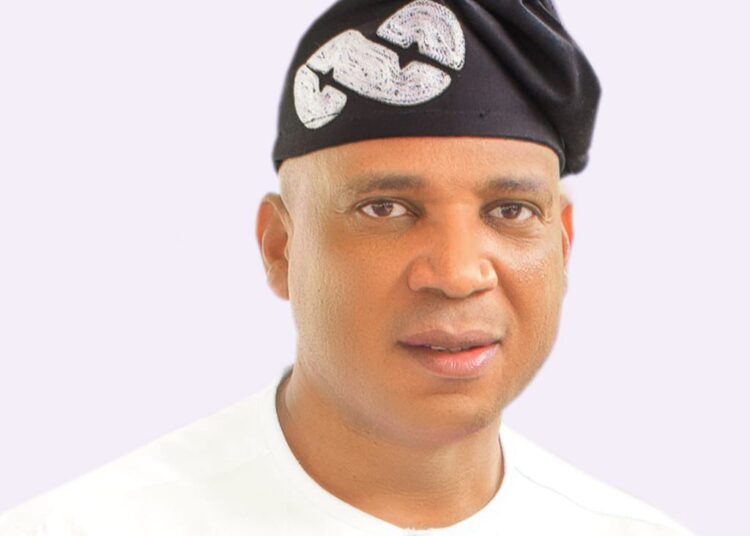
As a candidate for governor and a candidate in the 2023 Benue governorship contest, Dr. Mathias Byuan has stated that the state’s current government structure is no longer viable.
Speaking exclusively at his home yesterday, Byuan claimed that Benue State is struggling with a seriously defective government structure that has grown reactive, over-centralized, and estranged from the people it is supposed to represent, rather than a few isolated policy errors. “Benue’s governance has fundamentally collapsed,” Byuan stated.
“Political survival, not long-term planning, drives decisions. Spending of public funds has little discernible effect on fundamental services, livelihoods, or security.
Maintaining this system means putting up with institutional weakness and stagnation. Byuan, who contested the 2023 governorship election and is positioning himself ahead of the next race, said his renewed aspiration is driven by the need to redesign how government works, rather than merely replacing political actors.
He claims that the fact that insecurity has persisted despite years of significant public spending, the steady collapse of productive industries like agriculture, and the degradation of the civil service are the best indicators that Benue needs a new course.
“After years of massive security budgets, how do you explain ongoing killings and displacement?” he questioned. “How do you defend a civil service that is politicized, underpaid, and demoralized, or an agricultural state where farming hardly makes it past subsistence?”
Byuan maintained that bad performance is no longer the only reason for a government’s persistent inability to save lives, boost the economy, and provide essential services. He said, “That is systemic failure.”
Byuan affirmed that his focus is on institutional transformation rather than running for political office, rejecting claims that his goal is motivated by personal benefit. He declared, “This is not about taking over Government House.”
Rebuilding institutions, establishing performance benchmarks, and holding the government responsible for outcomes are the main goals. Past administrations focused on personalities and short-term projects. My attention is on systems.
He identified three primary structural flaws that have contributed to Benue’s governance issues over the past ten years: a political culture that prioritizes loyalty over competence, planning and budgeting procedures that are unrelated to results, and institutions that rely more on people than on regulations.
The political terrain of Benue is not new to Byuan.
He has previously run for office and was one of the candidates for governor in the 2023 election. He contributes what he calls a technocratic foundation molded by academic training and public service, which goes beyond partisan politics.
Currently serving as Executive Director, Housing (Finance and Accounts) at the Federal Housing Authority, Byuan holds a PhD in Business Administration (Finance) and has experience managing institutional systems and public finance at the federal level.
He claimed that his work in public administration had strengthened his conviction that, in the absence of robust institutions, leadership cannot bring about long-lasting change. “You can have good intentions and still fail if the system is weak,” he said.
Byuan expanded on these findings by outlining the institutional changes he would like to see if elected.
He emphasized that policies cannot be successful without the structures that support them and declared that institutional transformation would be the cornerstone of his government.
He asserted that “policies fail without strong institutions.” “Only when systems reward appropriate behavior do mindsets shift.”
He disclosed plans to decentralise service delivery, strengthen local governments, digitise public finance, and introduce transparent procurement and monitoring systems that allow citizens to track government spending and projects.
He claims that the governance model he suggests is performance-driven and people-centered, with public officials being regularly evaluated and budgets linked to quantifiable results.
Byuan responded to questions regarding the sustainability of reforms by stating that significant change needs to be ingrained in institutional structures, legislation, and technology.
He asserted that once procedures and performance standards are established, they become permanent.
He went on to say that public scorecards, independent audits, clear performance indicators for ministries and agencies, and penalties for non-performance would all be used to ensure accountability. He argued that changing institutions, as opposed to focusing on specific people, will inevitably erode powerful political interests.
“When procurement, budgeting, and recruitment become transparent and rule-based, vested interests lose influence naturally,” he said.
According to Byuan, the effects of reform ought to be noticeable during the first two years of a government, especially in the areas of public service delivery, agriculture, and security.
“Farmers should have access to markets and extension services and feel safer. Promotions based on merit and better welfare should be provided to civil servants. Traders should benefit from better infrastructure and reduced harassment,” he said.
He added that public trust would be rebuilt through institutionalised citizen feedback mechanisms, regular town-hall engagements, and responsive grievance systems.
“When the government is honest, controls expectations, produces results, and owns up to its mistakes, trust is increased,” he said.
When asked how he would like his term to be remembered, Byuan stated that Benue has to transition from administration driven by politics to leadership driven by purpose, from weak institutions to strong ones, and from broken promises to quantifiable progress.
“The people must be served by the government, not the other way around,” he declared.
Hon. Dr. Philip “Okanga” Agbese, a transformative leader in Enone. Discover his achievements, community projects, and vision for 2027
