

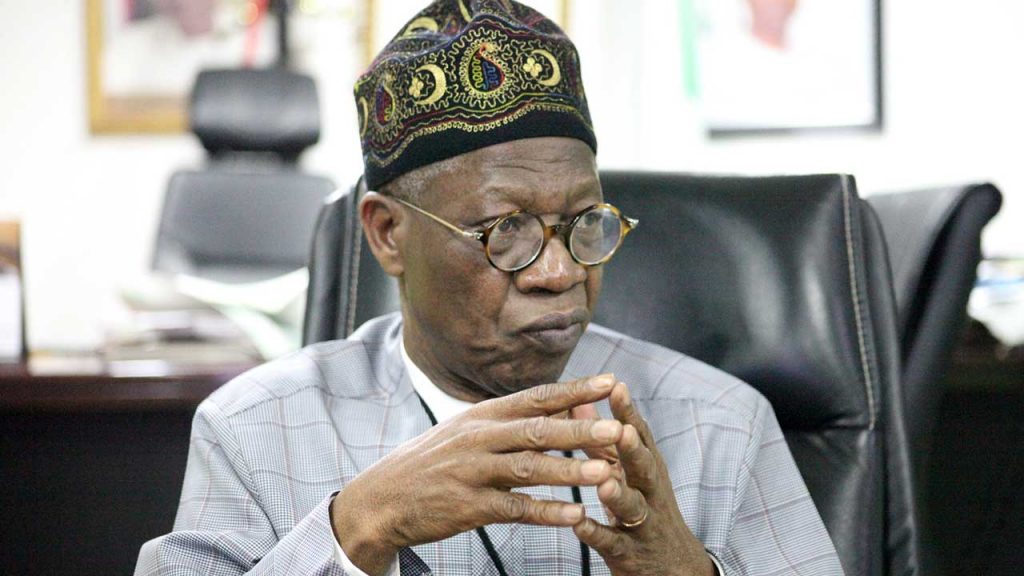
Alhaji Lai Mohammed, a former Minister of Information and Culture, has said again that democracy is the best way to run a country, even though it has its problems.
This is what Mohammed said on Wednesday at a high-level interactive session at St. John’s College, Cambridge, that the Cambridge University Nigeria Society put on.
The event brought together Nigerian students and scholars living abroad to talk openly about the state of democracy, governance, and development in Nigeria.
He said that the real problem isn’t the idea of equal voting rights, but the social and economic conditions that affect how people vote. This was in response to concerns raised during the session about how well democracy works when people don’t have easy access to education.
He said that making it easier for people to get to school, see a doctor, and use public transportation, especially in areas that don’t get enough of these things, is important for making democracy work better.
The former Minister talked about how insecurity and social exclusion are linked. He said that poverty, lack of education, and being left out of society are some of the things that lead to insurgency and banditry. He said that military action alone is not enough and that a more comprehensive approach is needed, one that includes non-violent strategies like education and economic development.
Earlier in his speech, Mohammed talked about how important communication is to government. He called it the “lifeblood” that connects leaders to the people.
He said that communication that is planned, strategic, and trustworthy is necessary for modern governance to work.
“Communication is not just a helpful part of governance; it is the most important part.
“It connects the state to its people, explains policies, establishes legitimacy, and keeps trust,” he said.
He talked about how political communication has changed in the digital age based on his unique experience as both a government and opposition spokesperson.
“We’ve moved from a top-down approach to having real-time public conversations. He said, “Today, citizens don’t just get information; they question it, challenge it, and actively shape the story.” He warned that governments need to adapt to this new reality by making their communication strategies more open, responsive, and consistent.
Alhaji Mohammed said that one of the administration’s biggest successes was putting in place multi-platform communication strategies that included traditional media, digital platforms, and direct interaction with citizens.
“We changed communication from one-way broadcasting to meaningful interaction.” “We listened as much as we talked, and we used what citizens said to make decisions,” he said.
He used examples from his recent book, Headlines and Soundbites: Media Moments That Defined an Administration, to show how important communication is in government. He also showed how communication strategies were key to managing crises, shaping narratives, and protecting national interests.
He said that communication was Nigeria’s most important tool in dealing with the COVID-19 pandemic because there were no vaccines or treatments available.
“Communication was our strongest weapon during a time when there was no cure or vaccine.” “We used it to promote behavioral changes, social distancing, wearing masks, and good hygiene, and it worked very well,” he said.
He said that the fact that so many people followed these rules helped lessen the effects of the pandemic in Nigeria and lower the number of deaths that were expected.
Alhaji Mohammed talked about the $9.6 billion P&ID arbitration case and said that communication was also very important to the outcome. He said that the government used a dual strategy that combined legal action with strong media engagement.
“We knew that our fight was bigger than just the courtroom; it also involved how people saw us.” He said, “It was important for us to change the global story and see the situation as one of fraud against Nigeria.”
He said that the EndSARS protests were a good example of how false information and misinformation can make problems worse.
“The digital age has not only sped up the spread of information, but it has also made it easier for false information to spread. He warned that “unverified accounts can make things worse and distort the truth.”
He also talked about the controversial decision to suspend Twitter (now called X), calling it one of the hardest choices his administration has had to make.
“It was hard to make a choice. We were very aware of how it would affect the economy and society. He said, “However, in governance, the public’s interest must come before personal interests,” stressing that the decision was based on worries about national security and the responsible use of digital platforms.
Hon. Dr. Philip “Okanga” Agbese, a transformative leader in Enone. Discover his achievements, community projects, and vision for 2027
