

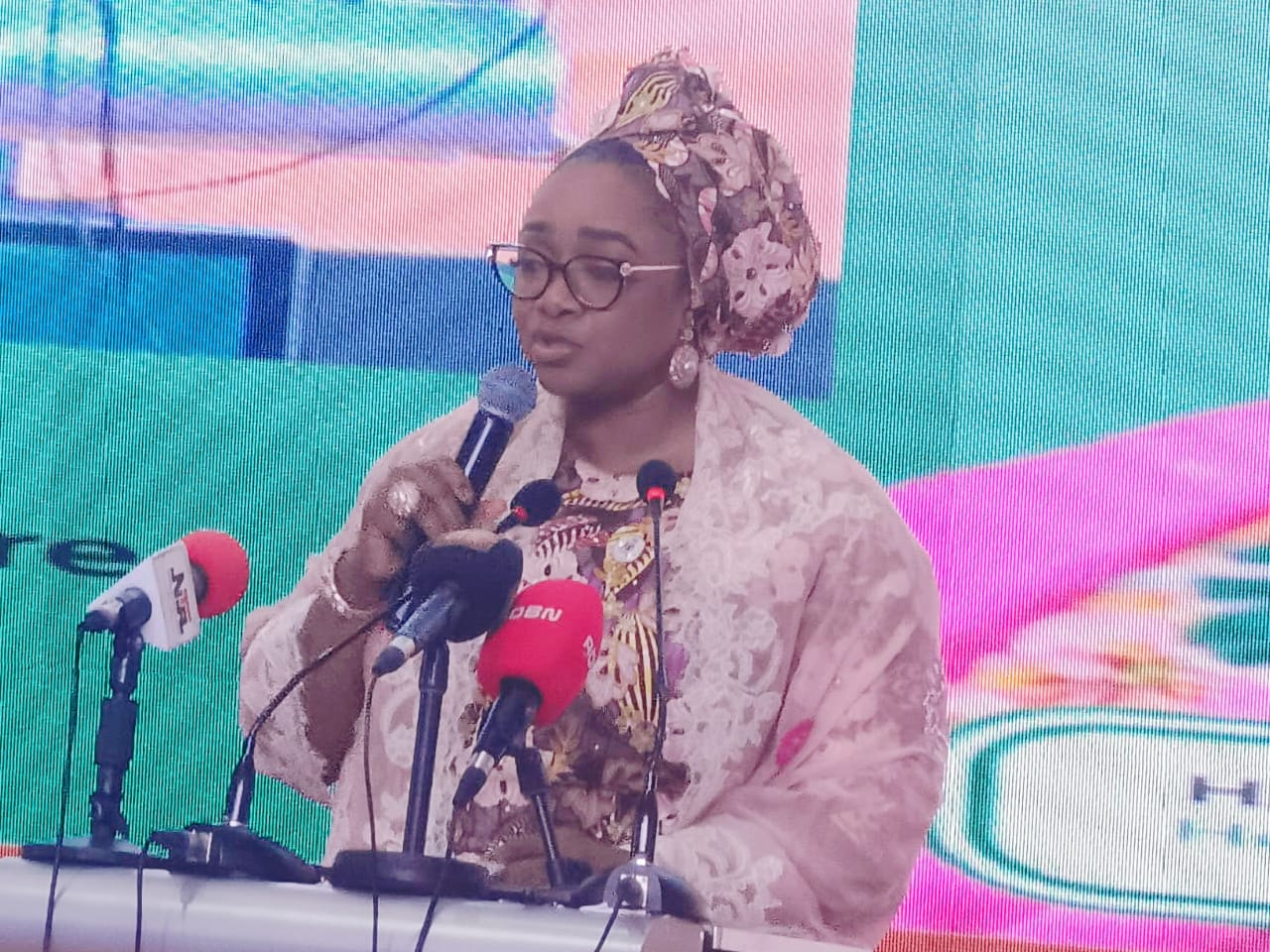
Imaan Sulaiman-Ibrahim, the Minister of Women Affairs and Social Development has repositioned Nigeria’s care economy as a strategic catalyst for inclusive growth, social protection and national development.
The minister, who spoke at the 2026 National Caregivers Summit marking National Children’s Day in Abuja, said the administration of President Bola Ahmed Tinubu is pursuing a people-centred governance model under the Renewed Hope Agenda. He unveiled a policy-driven framework designed to strengthen families, protect vulnerable groups and create economic opportunities through structured caregiving systems nationwide.
According to her, the Renewed Hope Social Impact Intervention Programme was designed to guarantee that social protection and human capital interventions reach all the 774 local government areas across the country.
She said: “It is a historic transition from seeing social development as charity to seeing it as a national economic imperative.
The minister said President Tinubu’s declaration of 2026 as the “Year of Families and Social Development” was an indication of government’s recognition of the family as “the first school of values, the first line of security and the foundational economic unit of society”.
“When we secure the home, we secure the future of Nigeria,” she said.
Sulaiman-Ibrahim disclosed that the ministry had embarked on institutional reforms to strengthen child protection systems and improve social inclusion mechanisms across the country.
“We have intensified efforts towards the full domestication and implementation of the Child Rights Act across the Federation and the Violence Against Persons Prohibition Act to ensure stronger implementation,” she said.
There were already National Costed Action Plans for some areas such as violence against children, child marriage and exploitation against women and girls with measurable targets, clear timelines and sustainable financing mechanisms, the minister said.
The ministry was working with relevant agencies to leverage the Nigeria Education Data Infrastructure to digitise social development data and track vulnerabilities in real time to improve planning and response systems, she said.
“We are leveraging the Nigeria Education Data Infrastructure (NEDI) to digitize social development data so that we can track in real-time educational gaps, vulnerabilities, and exclusion indicators so that no Nigerian child or vulnerable household remains invisible in our development architecture,” she said.
The minister pointed to demographic pressures on national care systems, saying Nigeria’s fast-growing youth and elderly populations need urgent investment in social infrastructure.
“More than 6.5 million Nigerians are now 65 years and older,” she said, adding that women and girls still carry the disproportionate burden of unpaid care responsibilities. “No country can be prosperous sustainably if a big part of its productive population is held back by invisible and unrecognized care responsibilities,” she said.
The minister said the government was now “officially recognising that caregiving is not an invisible domestic obligation, but a vital professional sector worthy of structure, standards, investment and dignity.”
She said the ministry was scaling up nationwide training and certification programmes to professionalise caregiving services, through partnerships with stakeholders such as the Caregiver Nigeria Society.
“Our aim is to train thousands of Nigerian youths with employable and globally relevant skills in childcare, geriatric care, special needs support, and community caregiving services. “By formalising the care sector we are creating pathways for sustainable employment and at the same time allowing more women to actively participate in the economy.
The minister further underscored the ongoing joint work with the World Bank on the AGILE Project to expand educational access and digital literacy for over 8.6 million girls in 18 states.
“This is not just about education, it is about breaking cycles of poverty, fostering inclusion and equipping Nigerian girls to become leaders, innovators and contributors to national development in the digital age,” she said.
She said the ministry is at an advanced stage of establishing dedicated institutional departments for the Care Economy and Women’s Climate Resilience and Adaptation in collaboration with the Ministries of Environment, Agriculture and Humanitarian Affairs.
Blessing Adesinyo, CEO, Caring in Africa, said the care economy was critical for workforce participation and economic growth.
“Care as infrastructure: a national imperative for growth,” she added.
Adesinyo quoted UN Women as saying that unpaid care work around the world, carried out mostly by women, was worth $11.7 trillion.
“Do the maths that is about 10 countries, the GDP of this country that women provide for free.”
She explained that Nigeria is at a demographic and economic inflection point and is expected to be the world’s third most populous country after India and China.
“We add nearly 10 million babies to our country every year. And for those 10 million, we have no structure of how they will actually feed, educate and add value to our economy.” “We have 10 million people. Nigeria is growing every year.
Beatrice Eyong, the UN Women Representative to Nigeria and ECOWAS said caregiving systems were important for women’s participation in politics, careers and economic life.
“For a young woman who wants to get into a career, who wants to get into the economic space, who wants to get into political participation and representation, they need care,” she said.
Eyong assured that UN Women would continue to provide technical support to push Nigeria’s care economy agenda forward.
Godwin Chinedu Odo, speaking on behalf of the UNICEF Nigeria Country Director, reiterated the organisation’s commitment to supporting care reforms and child protection systems in collaboration with the ministry.
Odo said UNICEF had contributed to the development of alternative care guidelines and implementation strategies that were guiding the provision of care services in Nigeria.
At UNICEF we believe that the best place for a child is at home. “We encourage that children should be at home with their loved ones and alternative care service provision should only be as a last resort,” he said.
Oghogho Musa, wife of the Minister of Defence, said the summit was a good starting point and was timely.
“I want to congratulate the Honourable Minister for bringing this on board because it’s really a big economy, and so we are urging all of you to be part of this movement,” she said.
The summit also witnessed the unveiling of the six-part book series, The Etiquette Adventure, written by Etienying Akpan Usong of the Etiquette Africa Initiative.
Stakeholders welcomed the move, but urged swift implementation of reforms to empower families, safeguard children and unleash economic opportunities.
Hon. Dr. Philip “Okanga” Agbese, a transformative leader in Enone. Discover his achievements, community projects, and vision for 2027
