

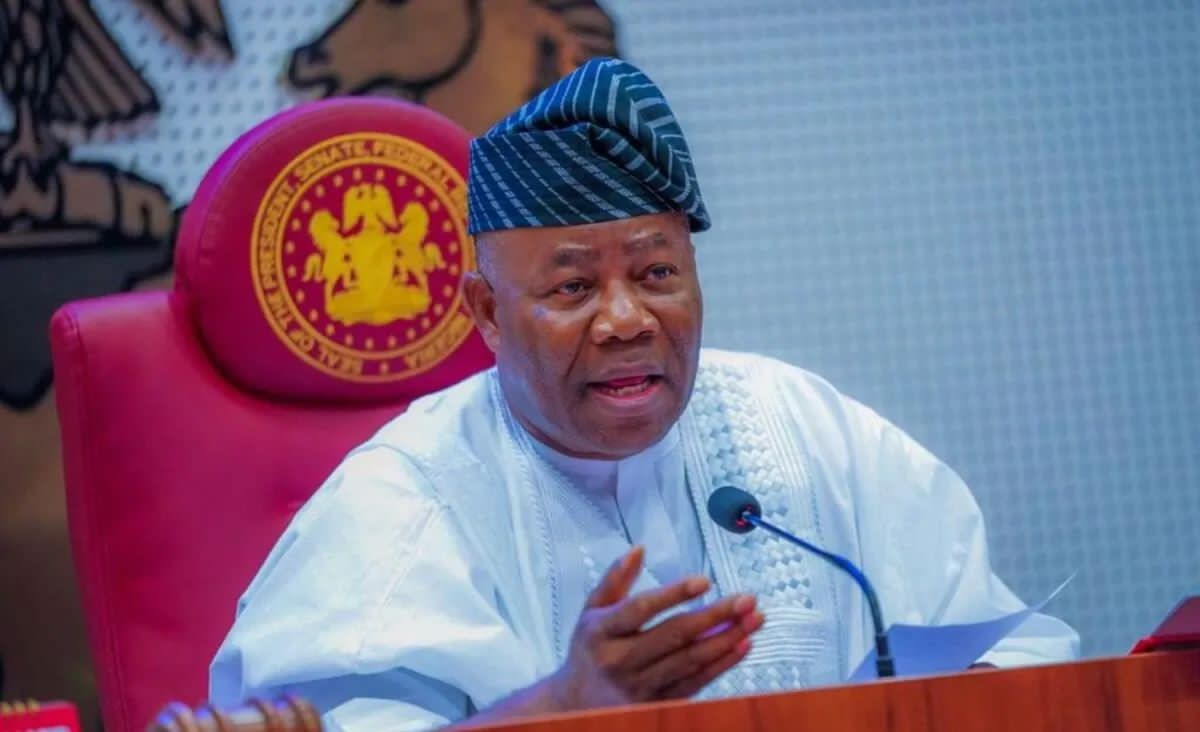
According to Senate President Godswill Akpabio, President Bola Tinubu’s signing of the Electoral Act 2026 (Amendment) on Wednesday will guarantee that every Nigerian vote counts.
According to Akpabio, the new law resolves the enduring issue of collation centers and polling stations manipulating results.
Shortly following the signing ceremony at the Presidential Villa in Abuja, Akpabio told reporters that the new law incorporates measures to improve the security and transparency of future elections while addressing the fundamental issues brought up by Nigerians over the integrity of the electoral process.
“Future elections will ultimately be very beneficial to Nigerians. The Senate President declared, “Now, every vote counts.”
Nigeria’s electoral rules would now recognize electronic transmission of results for the first time since the country’s independence in 1960, he said.
After numerous accusations of result manipulation during the general elections in 2023, Akpabio clarified that the amended Act requires the electronic transmission of polling unit results to the INEC Result Viewing Portal, which was a major demand made by opposition parties, civil society organizations, and election observers.
But he added that the law also included places with inadequate telecommunications infrastructure, guaranteeing that the EC8A forms, which are signed by polling station security staff, party agents, and presiding officers, will continue to be the major source of results.
We considered places where there might not be a network, where there might not be availability or communication capabilities.
We stated that copies are distributed to everyone because the polling unit results are obtained via EC8A, which is signed by the presiding officer, the agents, and security personnel.
He stated, “Then we can use that as the primary source of collation at that unit.”
“Then, of course, we transmit it,” Akpabio continued. People can still view it even if there is no network at the moment because it will drop into the iREV as we leave, possibly heading to the ward center or the local government center.
The upshot, according to the Senate President, is that Nigerians would now be able to compare results that are uploaded to the portal with those that are ultimately compiled at the state, local government, and ward levels, making it impossible for results to be altered once they leave polling places.
That implies that Nigerians would be able to compare whether the election results were altered with if the final results at the next center differ from those in the iREV.
“And for us, the issue in the nation has always been that election results are tampered with or disfigured once they leave a voting station. Today, that has been eliminated,” he declared.
The Senate President denied rumors that the National Assembly had given in to political pressure, stating that the amendment’s final elements were the result of extensive discussions and consultations in both chambers’ plenary sessions.
The Senate even gave up its holiday break to finish the amendment, he added, adding, “We are satisfied that we have met the aspiration of Nigerians, not those who are politically motivated.”
Other elements in the new law that Akpabio emphasized were the establishment of direct primaries for political parties, which will enable party members to vote directly for the candidates of their choice instead of depending on delegate selection.
“More inclusivity and participatory democracy.” Direct primaries can now be held by members of several political parties.
This implies that you are free to select the individual of your choice. Of course, one individual can prepare the list and submit it for delegate selection, but this time, the political party members will take a stand and cast their votes for their own candidates as well as those of their choosing,” he said.
According to the Senate President, the change also tackles situations in which judges disqualify election winners. He notes that the legislation now requires new elections rather than naming the runner-up as the winner in order to guarantee that Nigerians actually choose their leaders.
“In an election, we don’t want a scenario where five candidates run, one receives 300,000 votes, another 290,000, and the court disqualifies him for some reason. Then, the person who received 1,000 votes, who isn’t elected by the majority, is declared the winner.
“All of those items have been removed. We now advise them to call for another election in such a situation,” he stated.
He pointed out that the same rule currently governs gubernatorial elections, thus even if a candidate receives the second-highest number of votes, they cannot be proclaimed the victor if they do not receive at least 25% of the votes in two-thirds of local government districts.
During his remarks to reporters, Speaker of the House of Representatives Abbas Tajudeen highlighted the shortening of the election notice time from 360 to 300 days.
“This may unintentionally result in the presidential and National Assembly elections taking place in January 2027, which will technically prevent elections from taking place during 2027 Ramadan.
“I believe that this is yet another clever move by the National Assembly to prevent voter disinterest in the upcoming general election,” the Speaker stated.
Days after INEC published the schedule for the general elections in 2027, the Electoral Act 2026 (Amendment) was announced.
When INEC’s Result Viewing Portal failed on the day of the 2023 elections, leading to accusations of election tampering, the 2022 Electoral Act was criticized.Our correspondent saw Tinubu introduce the Electoral Act 2026 (Amendment) at a signing ceremony at the Presidential Villa in Abuja at approximately 5:00 p.m., with the National Assembly’s senior officials present.
For the 2027 general elections, the governorship and state houses of assembly elections are set for March 6 and the presidential and national assembly elections for February 20.
Hon. Dr. Philip “Okanga” Agbese, a transformative leader in Enone. Discover his achievements, community projects, and vision for 2027
