

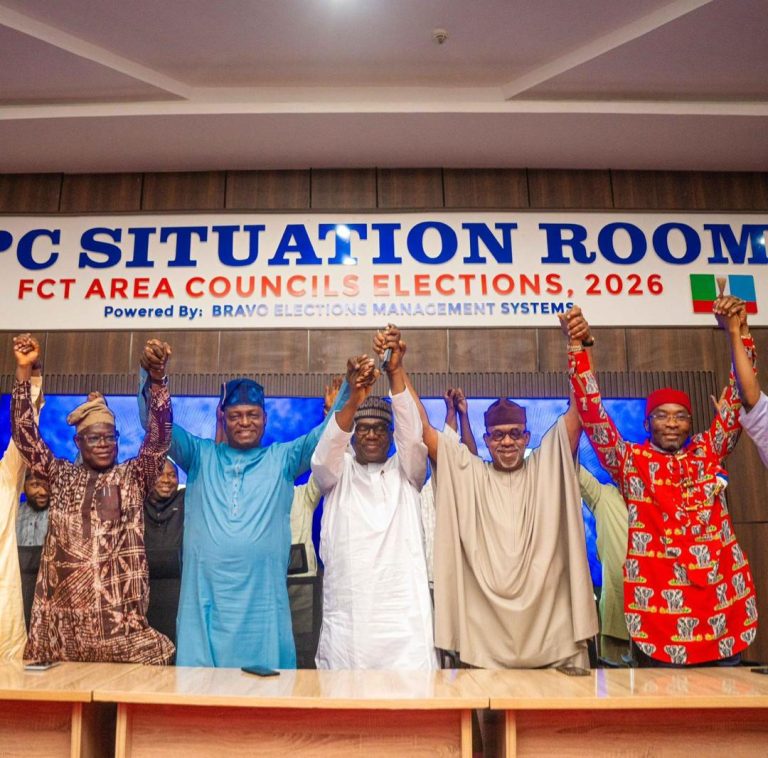
Five of the six Area Councils in the nation’s capital have been won by the ruling All Progressives Congress (APC), strengthening its hold on the Federal Capital Territory (FCT) ahead of the 2027 general election.
The successful holding of Saturday’s elections in the Federal Capital Territory (FCT) and the by-elections in the states of Rivers and Kano was praised by President Bola Tinubu yesterday, who said that it had further reinforced the nation’s democratic institutions and culture.
Professor Nentawe Yilwatda, the APC’s national chairman, said the party’s wins in the Federal Capital Territory and the by-elections in the states of Kano and Rivers were a resounding indication of its tenacity, cohesion, and grassroots power.
Nyesom Wike, the FCT Minister, praised Tinubu for the way the FCT area council elections were conducted on Saturday, claiming that the results have shown emergency Democrats to be unimpressed with the nation and its leadership.
Under the direction of Ogun State Governor Dapo Abiodun, the Southern Governors’ Forum praised the APC’s success, stating that it reflects the broad acceptance of the party among Nigerians.
According to the APC’s Lagos State chapter, the election results are a positive reflection of Tinubu’s accomplishments.
However, the Independent National Electoral Commission (INEC) was urged by the People’s Democratic Party (PDP) to make the results of two Kuje Area Council wards available right away. According to the PDP, there were signs that it was leading both councils.
Additionally, the party praised its candidates who won the FCT elections.
Similarly, despite internal difficulties and political pressure, PDP presidential candidate Dr. Gbenga Hashim said the results of the FCT polls were clear proof that the party was regaining ground before the general election in 2027.
As of yesterday, the national leadership of the African Democratic Congress (ADC), the opposition coalition party, had not released an official statement about Saturday’s elections.
However, Dr. Moses Paul, the ADC’s candidate for chairmanship of the Abuja Municipal Area Council (AMAC), refused to accept loss, pointing to evidence of anomalies in the election and promising to keep fighting for the mandate of the people.
However, during the FCT elections, INEC refused to allow voters to migrate to new polling places that were different from their original polling places. Additionally, officials from the Economic and Financial Crimes Commission (EFCC) stated that they detained 20 people during the FCT elections on suspicion of committing various electoral offenses.
The Abuja Municipal Area Council (AMAC), Kwali, Kuje, Bwari, and Abaji were won by the APC in the Saturday, February 21 FCT Area Council elections, while Gwagwalada was won by the PDP.
Mohammed Kasim of the PDP was proclaimed the victor of the Gwagwalada Area Council chairmanship election by INEC on Sunday morning.
In a fiercely contested election, Mohammed received 22,165 votes to win a landslide victory, while APC candidate Yahaya Shehu came in second with 17,788 votes, according to INEC Returning Officer Philip Akpen.
Mohammed complied with the legal procedures to be reinstated as the duly elected chairman, Akpen said.
Despite the high stakes, he called the election process “peaceful and smooth.”
Daniel Nuhu of the APC was also proclaimed the winner of the Kwali Area Council chairmanship election by the electoral umpire. With 17,032 votes, Nuhu defeated PDP candidate Haruna Pai, who received 8,575 votes and finished second in the election.
Joshua Ishaku of the APC was proclaimed the winner of the Bwari Area Council chairmanship election by INEC.
When announcing the results, returning officer Mohammed Nurudeen stated that Ishaku received 18,466 votes in total to win the election.
The APC’s Zakka Christopher was proclaimed the winner of the AMAC chairperson election by the commission.
The PDP received 3,398 votes, while the APC candidate received 40,295 votes, defeating the ADC, which received 12,109 votes.
The ruling party’s victory streak was extended when INEC announced Hon. The winner of the Abaji Area Council election was Abdullahi Abubakar of the APC. Abubakar received 15,535 votes in total.
The Young Progressives Party (YPP) candidate, who received 5,357 votes, was his closest opponent. With 4,547 votes, the PDP candidate was in last place, followed by the ADC with 37 and the New Nigeria Peoples Party (NNPP) with 53.
Additionally, INEC declared Hon. The APC’s Samuel Shekwolo won the election for the Kuje Area Council.
APC and Tinubu are thought to have strengthened their hold on Abuja in advance of the general election in 2027 as a result of the results of the FCT area council election.
Despite being an off-season exercise, the FCT election might not serve as a benchmark.
Tinubu: Democracy Has Been Strengthened by the Successful Polling in the FCT, Rivers, and Kano
The successful holding of Saturday’s elections in the Federal Capital Territory, Rivers, and Kano, according to President Bola Tinubu, has further reinforced democratic institutions and culture.
Tinubu urged INEC to keep up its good work in order to provide even more excellent election procedures.
The winners in FCT, Rivers, and Kano states were congratulated by the president in a statement issued by his adviser on information and strategy, Bayo Onanuga.
Tinubu advised the winners to see the mandate that the people had given them as a sacred trust and to serve with humility, patriotism, and dedication.
He praised Wike’s accomplishments in the FCT, which had benefited the ruling APC politically.
The APC’s national leadership, Kano and Rivers leaderships, and all party members were congratulated by the president on their electoral triumphs.
He praised voters, security forces, and INEC for the smooth and peaceful election process.
He also praised the bravery and self-control of all the candidates, saying that competition and participation provide vitality to democracy.
Yilwatda: The APC’s victories are a blatant example of grassroots power.
Professor Nentawe Yilwatda, the APC’s national chairman, said the party’s wins in the FCT and the by-elections in Kano and Rivers states were a resounding indication of its tenacity, cohesion, and grassroots power.
In a post on X, Yilwatda praised the discipline and commitment of party officials, followers, and stakeholders in the two states as well as the FCT.
He said, “I want to express my sincere congratulations to the throngs of All Progressives Congress (APC) supporters in the Federal Capital Territory, Kano, and Rivers States for the peaceful and successful holding of the polls on Saturday, February 21, 2026.
“Our great party’s tenacity, solidarity, and grassroots power are amply demonstrated by the successes that have been documented.
“I extend my sincere congratulations to the PDP chairmanship candidate who won in Gwagwalada and the five APC chairmanship candidates who won in AMAC, Kuje, Abaji, Bwari, and Kwali.
“Democracy has triumphed because the people have spoken through the ballot. Additionally, I would like to congratulate the four state candidates for the House of Assembly who won in the states of Kano and Rivers.
Wike: FCT Poll Results Have Revealed Emergency Democrats
The results have revealed emergency democrats, who see nothing positive in the nation and its leadership, said FCT Minister Nyesom Wike, who congratulated President Bola Tinubu on the peaceful conduct of the polls.
Wike claimed in a broadcast yesterday that Nigerians had seen the election results, which identified the country’s true opposition party and ruling party.
He said that the FCT’s citizens’ dedication to democracy and sound administration was demonstrated by the election’s peaceful conduct.
Wike stated, “The people of FCT showed that they cannot be fooled by emergency democrats, who have decided not to see anything positive in our nation and its government.”
He expressed gratitude to the president for the accomplishments he has made in FCT.
According to the minister, the election demonstrated Tinubu’s vision and leadership and demonstrated how the Renewed Hope Agenda had given the people of the Federal Capital Territory hope and confidence.
“This election has demonstrated that Nigerians are now aware of the ruling party and the true opposition party,” he said.
Additionally, the election has highlighted the hypocrisy of those who purchase grain and groundnuts from street vendors for political campaigns in an attempt to mislead Nigerians.
“The people of the Federal Capital Territory showed yesterday that emergency Democrats, who have decided to see nothing positive in our nation and its government, cannot fool them.
“I express my gratitude to the President for the development he has brought about in the FCT. This election is a testament to the president’s vision and leadership, as well as to the fact that the FCT’s citizens now have hope and confidence thanks to the Renewed Hope Agenda.
President Bola Ahmed Tinubu’s dedication to enhancing the quality of life for Nigerians, especially those living in the Federal Capital Territory, has undoubtedly been acknowledged.
“We have hope for a better future thanks to the Renewed Hope Agenda, and we are sure that the FCT will remain a model of growth and advancement under his direction.”
Wike went on to say, “I applaud the president for his unwavering support of democracy, especially in securing the Electoral Act’s modification to improve the conduct of fair elections. This illustrates his dedication to enhancing our democratic system.
“At this point, I also want to thank the Independent National Electoral Commission (INEC) for holding an election that was credible, free, and fair. This demonstrates President Tinubu’s dedication to bolstering our democratic institutions and guaranteeing the integrity and transparency of our election procedures.
Southern Governors’ Forum Applauds APC and Tinubu
The Southern Governors’ Forum, led by Ogun State Governor Dapo Abiodun, praised the APC’s performance in the area council elections, claiming that the party’s high turnout reflects Nigerians’ broad support for it.
Abiodun characterized the APC’s impressive result as a support for Tinubu’s Renewed Hope Agenda in a statement released in Abeokuta.
Abiodun said the party’s performance at the polls was a sign of its upcoming victory in the general election in 2027. He thanked the president, APC chairman, Professor Nentawe Yilwatda, and the APC candidates on their outstanding performance.
The governor declared, “There is no question that the results of the FCT’s area council elections have made it abundantly evident that Nigerians are completely in agreement with President Bola Tinubu and the APC, and they will once more show this at the general election in 2027.
The great majority of Nigerians are aware that their country’s future is secure while the APC is in power. I commend President Bola Tinubu and the APC leadership for this outstanding performance, which is a sign of our triumph in 2027.
Lagos APC: A Referendum on the Legacy of Tinubu
The outcomes of Saturday’s elections in the Federal Capital Territory, Kano, and Rivers, according to the Lagos State Chapter of the APC, are evidence of President Bola Tinubu’s good work.
The results were the “profound appreciation to the good people of Rivers and Kano States, the Federal Capital Territory (FCT), and Nigerians at large for their overwhelming support for our great party and the president in the just concluded by-elections,” the party insisted in a statement released by its spokesperson, Seye Oladejo.
Oladejo claims that the results of the by-elections in all impacted areas constitute an unmistakable and transparent referendum on Tinubu’s leadership and the progressive principles that still serve as the foundation for national administration.
“Our candidates’ overwhelming wins confirm the electorate’s faith in the Renewed Hope Agenda and the revolutionary policies being enacted at the federal and state levels,” Oladejo said.
“The people have made their voices heard through the ballot at a time when critics and opposition elements have attempted to distort the country’s course.
“These findings show that when Nigerians witness strong leadership, economic reforms, infrastructure development, and institutional fortification, they recognize them.”
ADC Candidate Promises to Keep Fighting for the Future of AMAC
Dr. Moses Paul, the ADC chairman candidate for the Abuja Municipal Area Council (AMAC), promised to keep fighting for the people’s mandate regardless of the results of the poll. He said that INEC’s results contained poll fraud.
Paul said, “Today, I stand before you as a man enlarged by a movement, not a man diminished by an outcome.”
“A movement born of conviction, not convenience,” he continued. a movement driven by people, not by authority. A sacrifice-based movement rather than one inscribed in ink.
Paul said, “You rose,” praising the bravery and tenacity of the AMAC people. You got up. You took a step. You said something. You had faith. And I bow my head in appreciation for that.
He emphasized that the fight to improve AMAC would go on.
He declared, “No force in history has ever defeated an idea whose time has come.”
With a promise to stay dedicated to their mission, the ADC candidate thanked volunteers, supporters, and the people of AMAC.
“I still answer to you,” he said. I’m still one of you. Our adventure does not finish here. This marks the start of a lasting awakening.
Kano Assembly By-elections Are Won by the APC
In Kano State’s Kano Municipal and Ungogo local government districts, the APC won both seats in the by-election held on Saturday.
The APC’s Nabil Aliyu Daneji and Aminu Sa’ad Sa’ad were proclaimed the winners by INEC in the elections to replace the parliamentary vacancies in the Kano Municipal and Ungogo seats, respectively.
Professor Ibrahim Tajo Siraj, the Kano Municipal Returning Officer, declared that Daneji had won 7,484 votes, defeating eight other candidates.
The announcement, which confirmed the APC’s victory in the election, came after the results from the impacted polling places were compiled.
Sa’ad received 8,975 votes, more than any other contender, and was proclaimed the winner of the Ungogo constituency by Returning Officer Professor Ali Tijjani Abdullahi.
Abdullahi praised the collaboration of political parties, observers, and voters and confirmed that the result represented the will of the people.
The Kwankwasiyya movement clarified, however, that Rabiu Kwankwaso, the national leader of the New Nigeria Peoples Party (NNPP), was the one who first proposed the two APC candidates in the Kano State by-elections.
Habibu Sale Mohammed, the group’s spokesperson, stated in a statement that Kwankwaso nominated the two candidates’ sons prior to their joining the APC.
He said that Kwankwaso’s choice to name the lawmakers’ boys was an homage to their fathers, who died that same day while they were serving in the state House of Assembly on the NNPP platform.
“National Leader Rabiu Musa Kwankwaso supported the nomination of their children as party flag bearers in an effort to honor their memory and demonstrate compassion,” the statement read. The lawmakers’ sacrifices and dedication to the party were acknowledged with this decision.
PDP Applauds All Winning Candidates and Requests INEC to Announce Kuje Results
The PDP leadership demanded that INEC make the results of the Kuje Area Council’s two ward elections public.
The party’s slight advantage in the two wards sparked concerns about manipulation.
“We are concerned that INEC has not yet announced the results from two wards in Kuje Area Council,” the PDP stated in a statement issued by Ini Ememobong, National Publicity Secretary.
Because of the Peoples Democratic Party’s slim lead there—which, as we know, is vulnerable to manipulation by security forces—this delay has caused anxiety.
The results in Kuje Central and Kabi Wards, the majority of which have been posted on the IREV, should be announced right away, we urge the INEC chairman.
“Anything less renders the entire process invalid; election results must continue to accurately reflect the people’s votes.” We ought to protect the ballot’s integrity.
The FCT election saw the PDP celebrate its victorious candidates.
“This victory, though fewer than we expected, is particularly gladdening because it comes against the backdrop of unprecedented intimidation, high-powered money politics, and brazen executive brigandage,” the party added in another statement from Emeombong.
There are several reports and video proof of armed security guards being deployed to intimidate voters, carry away result sheets in polling places, and improperly affect the election’s outcome.
We would especially want to congratulate Mohammed Kasim, the chairman-elect of the Gwagwalada Area Council, and the council members who have been deemed successful by the Independent National Electoral Commission (INEC).
“We have established a special legal team, led by National Legal Adviser Shafi Bara’u, Esq., to assist with post-election litigation and to address candidates with legitimate grievances resulting from these elections.
“Delay is fatal in election petition cases, so they should contact the National Legal Adviser right away for prompt action.”
Voter apathy in the polls, according to Emeombong, was a direct result of the anti-people Electoral Act 2026, which caused people to lose faith in the results of elections held under the act.
Olawepo-Hashim: FCT Findings Point to the PDP’s Comeback Before the 2027 Elections
Despite internal difficulties and political pressure, PDP presidential candidate Gbenga Olawepo-Hashim characterized the results of the FCT elections as compelling proof that the party was regaining ground ahead of the general election in 2027.
Olawepo-Hashim responded to the results by praising party members and supporters for what he called a “outstanding performance under difficult circumstances.” He said the polls showed that the PDP is still structurally sound and competitive in the election despite internal issues.
“The PDP is a resurgent party,” he declared. The masses remained loyal to the party despite national leadership conflicts and intentional attempts to undermine our structure in the FCT.
“You cannot suppress structure,” he said, praising ward leaders, polling unit agents, and party followers in particular for their “unshakable loyalty to the party logo.” Conviction cannot be intimidated. The people at the bottom have spoken.
The CP-PDP praises the party for Gwagwalada and claims that the PDP won Kuje and two other seats.
Mohammed Kasim, the incoming chairman of the Gwagwalada Area Council, and the other council members were congratulated by the Conference of Professionals in the Peoples Democratic Party (CP-PDP) on winning the FCT council elections.
However, Obinna Nwachukwu, the chairman of the CP-PDP, warned of the APC’s purported intention to employ compromised security forces to terrorize the populace, inflict violence, and deny the PDP its victory in Kuje.
As the results from Kuje Central and Kabi wards, which received the most votes, were being held allegedly to rig the election for the APC, the conference claimed to have video evidence of the deployment of heavy security, who shot, scared, and carted away ballot boxes.
The Inspector General of Police was urged to step in and make sure that only the results that accurately represented the votes cast were declared, as the CP-PDP characterized the situation in Kuje as a formula for a major crisis in the FCT.
“Despite the repeated attacks, threats, intimidation, propaganda, lies, and extensive shenanigans by the APC using the FCT Minister, Chief Nyesom Wike, the PDP’s performance and manifest popularity in the FCT election further underscore the undisputed strength and potency of the PDP at the grassroots level across the country,” the CP-PDP said.
During the FCT Council Elections, INEC forbids voters from moving to different polling places.
During the FCT elections, INEC prohibited voters from moving to polling places other than their original ones.
at order to prevent traffic on election day, the commission established split polling stations at sizable polling places with more than 1,250 registered voters, according to a statement from INEC Voter Education and Publicity (VEP) Acting Director Wilfred Ifogah.
However, the commission saw that several voters had difficulty finding their assigned voting places, Ifogah said.
“The commission wishes to state unequivocally that voters were not migrated, despite the assertion in some quarters that some voters were moved to new or different polling places from their original polling places. Instead, the commission created split polling places in large polling places with more than 1,250 registered voters in order to prevent traffic on election day.
“The split units are situated on the same property, a few meters from the original polling places.”
“The public will remember that the commission displayed the register of voters at designated centers/split polling units four days prior to the Area Council elections to enable voters to confirm their details and polling unit locations,” Ifogah continued.
According to him, the impacted voters received emails and SMS messages on February 18, 19, 20, and 21 with the precise locations of their divided polling places. According to him, the notifications were only meant to serve as a reminder to help people locate their present polling places.
Ifogah stated that all polling places were verified to be open by 10 a.m. on election day, whereas 45% of polling places opened for voting at 8:30 a.m., according to the commission’s Election Operations Dashboard.
20 Are Arrested by EFCC for Electoral Fraud
According to EFCC operations, 20 people were detained yesterday on suspicion of committing various electoral offenses during the FCT elections.
According to a statement released by the anti-graft agency’s Head of Media and Publicity, Mr. Dele Oyewale, the offenders were taken into custody by local government councils within the Federal Capital Territory.
According to the statement, “The suspects were arrested throughout the Federal Capital Territory for offenses ranging from obstruction of officers to vote buying and selling, totaling N17,218,700 (seventeen million, two hundred and eighteen thousand, seven hundred Naira only).”
“In a car parked next to a polling station in the Kwali local government area, one of the suspects was taken into custody with N13,500,000 (Thirteen Million, Five Hundred Thousand Naira).”
Oyewale provided a breakdown of the numbers, revealing that four of the suspects were apprehended in the Kuje and Kwali council areas, nine were apprehended in Gwagwalada, and two were arrested in Abaji.
After the inquiry was finished, he added, all individuals who had been arrested will face charges in court.
THE SECOND LEAD
Senate Leader: The Electoral Act Was Shaped by CSOs, AGF, and INEC Prior to Tinubu’s “Swift” Assent
* argues that 24-hour presidential permission is justified after two years of consultation.
* Demands that the new law is a result of collective input rather than the legislature acting alone.
*To preserve democracy, Catholic bishops urge NASS to reconsider their stance on the Electoral Act.
*According to Akume, no human law is flawless.
Onyebuchi Ezigbo and Sunday Aborisade in Abuja
The “swift” presidential assent to the Electoral Act, 2026 has been justified by Senate Leader Opeyemi Bamidele, who has stated that the new law is the result of two years of intensive engagement with important stakeholders.
According to Bamidele, the Office of the Attorney-General of the Federation (OAGF), the Independent National Electoral Commission (INEC), development partners, and civil society organizations (CSOs) were among the stakeholders.
When Bamidele spoke, several people were worried about how quickly President Bola Tinubu signed the bill into law—just 24 hours after the National Assembly had communicated it.
The Senate leader maintained in a statement issued by his Directorate of Media and Public Affairs that the president’s quick consent was a reflection of the breadth of previous discussions that developed the legislation long before it was finally passed, rather than a hurried support.
According to Bamidele, the making of the Electoral Act, 2026 was “a collective work that involves nearly all critical stakeholders”. The National Assembly did not act alone, he said.
Before we finally finished the process, the National Assembly collaborated with a variety of stakeholders, including the OAGF, CSOs, INEC, and our development partners, Bamidele stated.
“As we were making progress, the stakeholders too were making their input, and all the inputs were incorporated in the Act.”
He said there was no need for a protracted executive review because of the thorough consultation and the time restrictions ahead of general election preparations in 2027.
“Given the current time constraints, I don’t think the executive needs days or weeks to review it before assent because we all contributed to it,” Bamidele said. Nigerians as a whole, not just the parliament, are responsible for its outcome.
In order to prevent any constitutional or administrative issues in the run-up to the next general election, the National Assembly had already standardized many drafts of the Electoral Bill 2026 that had been approved by both houses, especially Clause 60(3), before sending the completed text to the president.
The new electoral governance framework, which brought extensive reforms to promote institutional independence, improve transparency, and strengthen accountability in Nigeria’s election management system, went into effect with Tinubu’s approval.
The creation of a special fund for INEC under Section 3 of the legislation was one of the main elements.
According to Bamidele, the action ensured the commission’s operational stability, administrative continuity, and financial independence.
In an effort to remove last-minute financial bottlenecks, the law mandated that election money be released at least six months before to a general election.
Additionally, it gave INEC the authority to examine dubious results declarations made under pressure or against established protocols.
Additionally, the act mandated that election results be transmitted electronically.
Under Section 60(3), results from polling units must be transmitted electronically to INEC’s Result Viewing Portal (IReV). The act stipulates that any presiding officer who willfully obstructs this procedure gets a six-month jail sentence, a N500,000 fine, or both.
Bamidele clarified that although IReV improved openness by making polling unit results publicly available, it was not a platform for collation.
In the event that electronic transmission failed because of communication difficulties, he said, the law offered a conditional fallback to manual transmission using Form EC8A.
Section 47 further requires that the Bimodal Voter Accreditation System (BVAS) or any other INEC-recommended technology be used for voter accreditation.
According to the commission’s instructions, presiding officers have to confirm and authenticate the information provided by prospective voters.
In addition to technology, the law established more stringent accountability guidelines. A Resident election Commissioner (REC) is required by Section 74(1) to provide certified true copies of requested election documents within twenty-four hours of payment. A minimum of two years in prison without the possibility of a fine is imposed for noncompliance.
In the event that INEC failed, refused, or forgot to issue a certificate of return, Section 72(2) further stipulated that a certified true copy of a court decision proclaiming a winner was adequate for swearing-in.
By eliminating indirect primaries and restricting parties to direct and consensus options under Section 84(1-2), the act redesigned party primaries.
The goal of the reform, according to lawmakers, was to increase party member involvement and reduce the amount of money that delegate-based elections generate.
Section 77 required political parties to keep digital membership registers, provide membership cards, and submit the register to INEC at least 21 days prior to primaries, congresses, or conventions in order to bolster internal democracy.
In the impacted election, a party that did not comply was not allowed to run candidates.
Along with toughening penalties for election offenses like vote buying, impersonation, and result manipulation—which carry jail sentences or fines upon conviction—the measure also increased campaign expenditure caps to reflect current economic realities.
Other clauses encouraged conformity and inclusion.
For example, Section 54 created support systems for people with visual impairments, Section 49 permitted gender-sensitive queue arrangements when cultural norms demanded it, and Section 93(4) fined any political party that did not file accurate audited returns within the allotted time.
Bamidele insisted that the election Act, 2026, was a strengthening and improvement of Nigeria’s election system, despite persistent doubt in some civil society circles.
“The Act aims to strengthen democratic governance in Nigeria, decrease disputes, and improve electoral credibility,” he stated.
He reaffirmed that its quick agreement was the result of thorough, inclusive, and intentional legislative work rather than an act of haste.
Catholic Bishops Tell NASS to Review Their Position on the Electoral Act to Preserve Democracy
Under the auspices of the Catholic Bishops Conference of Nigeria (CBCN), Nigerian Catholic bishops urged the federal government and National Assembly members to immediately revise the Electoral Act in order to represent the will of the Nigerian people and protect the nation’s democracy from preventable threats.
The federal government, however, filed a lawsuit asking for tolerance and understanding regarding the problems caused by the modified Electoral Act, claiming that any flaws in the legislation can be fixed eventually.
The Archbishop of Owerri and CBCN President, Most Rev. Lucius Iwejuru Ugorji, spoke at the organization’s First Plenary session in Abuja and urged the National Assembly to immediately review the amended Electoral Act as it relates to the electronic transmission of election results in order to represent the wishes of the majority of Nigerians.
He claimed that in order to protect the nation’s democracy from preventable threats in the run-up to the general election in 2027, Catholic bishops had called for a reform of the electoral legislation.
“The National Assembly (NASS) should review its recent stance on electoral reform and work to restore the trust of Nigerians,” Ugorji said. “The Electoral Act should mandate that election results be transmitted in real-time from the Bimodal Voter Accreditation System (BVAS) at the polling station to the INEC Result Viewing (IReV) portal at the commission’s headquarters to prevent human intervention in the expressed will of the electorate going forward.
“This must be recognized since it is the people’s desire. This will encourage our country to have free, fair, and credible general elections. enacting a bill that allows for the manipulation of election results and is a watered-down version of the democratic will.
The president of CBCN reminded the National Assembly that the 2025 Tax Bill, which required digital filing, record-keeping, and payments nationwide, had already been passed.
Ugorji, who was leaving his role as head of the Bishops Conference, stated that lawmakers shouldn’t let themselves be seen as taking conflicting and inconsistent stances while passing legislation.
Regarding insecurity, Ugorji stated that the nation has been facing an increasing number of security issues. He also mentioned that Nigerians are still hearing heartbreaking stories about needless killings, mass funerals, and unending sorrow.
Additionally, he claimed that illegal mining connected to banditry activities and their foreign partners continued to cost the nation roughly $9 billion a year.
“The recent wave of mass kidnapping incidents by gunmen in Kwara, Kebbi, Niger, Kaduna, and Kogi States, involving many students, pupils, and worshippers, has increased tensions in the country,” he stated.
According to Ugorji, CBCN insisted that the federal government take proactive steps to apprehend and prosecute terrorists, bandits, and those who support them.
However, the federal administration said that significant attempts were made to address the nation’s problems on all fronts.
Speaking to the CBCN plenary, Senator George Akume, the Secretary to the Government of the Federation (SGF), stated that the nation was gradually overcoming the obstacles it faced.
One such area, according to Akume, where notable success has been made is the decrease in food prices. He also mentioned that many impoverished students are receiving loans to complete their education as a result of government interventions.
In response to worries raised by the newly signed modified Electoral Act, Akume stated that appropriate process was followed before the Bill was passed and that no human legislation was flawless.
He asked people who were unhappy with the revised Electoral Act to exercise patience and mentioned that any issues would be fixed eventually.
Regarding insecurity, Akume stated that numerous efforts were being made to address the issue, which he claimed was not unique to Nigeria.
Akume clarified that foreigners were responsible for the majority of banditry and terrorism assaults in various regions of the nation.
“I want to look at the situation holistically,” he said. I would want to point out that a large number of these arrested individuals do not speak English. They speak French, but their Hausa is quite weak. Is French spoken in Nigeria?”
Archbishop Ignatius Kaigama, the Catholic Archbishop of Abuja, had earlier in his homily emphasized the importance of respect for one another and dedication to the common good.
Although food prices in the nation are gradually declining, Kaigama voiced concern that fuel and transportation expenses have remained high, making life tough for Nigerians.
The intersection of Ramadan and Lent serves as a reminder of our common beginning and end, he said. Instead of violence, debates, and the pursuit of numerical advantage, it calls for a stronger commitment to the common good and greater respect for one another.
Regarding the electoral law, Kaigama encouraged the administration to make sure that the results of the general election in 2027 be transmitted electronically using a modern system.
Mr. Mike Omeri, the event’s chairman and speaker on the subject of “Power of Leadership,” stated that a good leader must possess humility, courage, and purpose.
“We need leaders who will work to close the wealth gap and prioritize the welfare of all Nigerians,” he stated.
Hon. Dr. Philip “Okanga” Agbese, a transformative leader in Enone. Discover his achievements, community projects, and vision for 2027
