

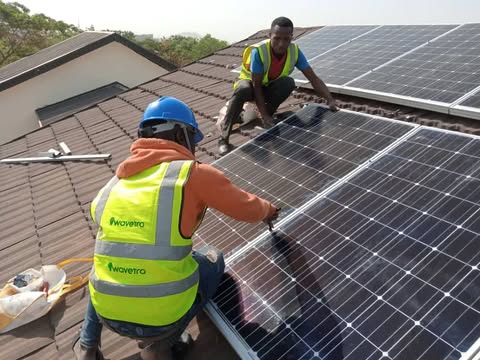
Recently, residents of the state were angry after a viral video on social media showed officials of the Lagos State Ministry of Housing confronting a resident over solar panels installed on his home.
In the video, officials from the ministry’s monitoring and compliance unit were seen asking the resident to seek approval and pay a fee before proceeding to install the pipeline.
But in response, the state government has said that permits and administrative fees for solar power installations apply only to residents of its social housing estates, not to private homeowners or tenants across the state.
People are angry, but it’s a complicated anger. Some are very angry that instead of the government appreciating the citizens for standing in the gap, it is going after the people with taxes.
But others cautioned that such requirements might hinder the adoption of renewable energy in a country plagued by ongoing power outages. Advocates on this side of the argument argue that the state government just wants to see its citizens in darkness and depression.
Reacting in an X post, Wale Ajetunmobi, senior special assistant on media to Lagos State Governor, Babajide Sanwo-Olu, said the policy was misunderstood by the resident.
“Not all residents are charged for solar installation by the state,” he said.
“This development is true, but the man who made the video appears to be misinformed about the Lagos State Government’s guidelines for installing solar energy systems in social housing estates,” he said.
Only residents of government-owned social housing estates are charged administrative fees for alterations, including the installation of solar power systems, he said.
Ajetunmobi said the requirement is tied to the government’s duty as facility manager of the estates, saying solar installations are treated as structural alterations, especially when they impact shared spaces or the original design of buildings.
“Only residents who own property on government-owned social housing estates are required to pay administrative fees for modifications such as the installation of a solar power system before any further development can be approved,” he said.
“Any alteration must be processed by the ministry of housing’s physical planning and survey departments for approval, material compliance and post-inspection checks.
“Those solar power systems are usually installed by the occupants in shared areas; so this change has to be approved by the facility manager (government) before any occupant can go ahead.”
The person in the video is likely a tenant who rented one of the government-owned estates from the property owner and does not fully understand the terms of the indemnity document, he added.
He said the officials seen in the video were from the ministry’s monitoring and compliance unit, adding that the resident did not seek prior approval before installation commencement.
He said the government had previously taken care of liabilities from unapproved modifications, including roof damage and fire incidents.
“He is probably a tenant in one of these social housing estates owned by the Lagos state government, otherwise he would not have raised concerns about something that was clearly documented in the indemnity document which he signed before the government handed him the apartment after he bought it.
“The general rule is that anybody living in an estate should approach the state government (facility manager) for permission before making any external changes.”
He said unapproved changes affecting shared property could leave the government liable for liabilities with other residents.
According to the Lagos State Urban and Regional Planning and Development Law, any structural changes made to buildings must be approved by the appropriate
authorities.
But what started as a government regulation over the installation of solar panels in the state-owned estates has spun into a heated public debate over governance, taxation, housing failure and the limits of state control in a city struggling with worsening economic hardship.
Residents, aside from condemning the government’s action, are calling for the scrapping of such a law as they view as commercialization of survival
For many Lagosians, the matter is more than about solar energy, but another layer in what they call a growing system of levies, approvals and charges placed on citizens who are already compelled to provide basic amenities for themselves.
Some quarters believe that while governments of developed societies subsidise the adoption of renewable energy, Lagosians are being asked to pay for the additional fees just to escape darkness.
Even the government clarification failed to assuage the people’s anger as tempers ran high in the entire state with many poised to take on the government authorities.
But many residents insist the policy is only a “pilot phase” that could eventually be applied to private estates and everyday homeowners across the state. So, their thinking is if they don’t react now, it would be too late when the government would want to extend it to private house owners.
There is concern in some quarters as to why citizens who already provide their own electricity, water and security, would be required to pay the government to install solar systems powered by sunlight; a natural gift to humanity.
A businessman living in one of the private estates in Amuwo Odofin area of Lagos, Anthony Osewele, lambasted the state government, saying, “The state government has no right to sell God’s energy.”
“When people decide to assume the position of God to themselves, you wonder whether they still had any iota of conscience in them.
” “It is not the right of anybody to sell the God-given energy of the sun. We are talking about solar energy that is from the Sun; God free gift to mankind. The sun is the center of universe . So, for me, it is evil and the height of wickedness for any one in authority to even think of collecting money from citizens for using sunlight. This means one day they will figure out a way to charge citizens for breathing the air. This is condemnable in all forms.
“We are talking about other climes where the government provides electricity to their citizens 24 hours nonstop. But here the government provides darkness making life hellish and short for the people.
And when the people move to provide alternatives just to better their lives, the government is here to add to their sorrow by taxing them for doing that. “(This) is very bad,” he said.
Also, supporting Osewele’s position is a lawyer, Marcellus Onah, who stressed that residents are not adopting solar power as a luxury, but as a necessity forced on them by the collapse of public electricity supply.
“People are going for solar because the government has failed to provide stable electricity which is the minimum any responsible government should provide.
“We generate our own water. We produce our own power. We repair the roads around us. All of these and the government still wants to charge us for trying to survive. “It is very bad and unacceptable,” he said.
Rowland Adebayo, an estate agent, also lamented that Lagosians are being strangulated by multiple taxes and levies without commensurate public services.
They have issued parking tickets on the road. They’re asking for tenement rates. Every day there’s a new levy or another.
“I don’t mind paying taxes if the government is doing right things.
“But forcing people to pay to have solar energy is criminal. It is like taxing sunlight which is a free gift from God and we must resist it,” he said.
Hon. Dr. Philip “Okanga” Agbese, a transformative leader in Enone. Discover his achievements, community projects, and vision for 2027
