

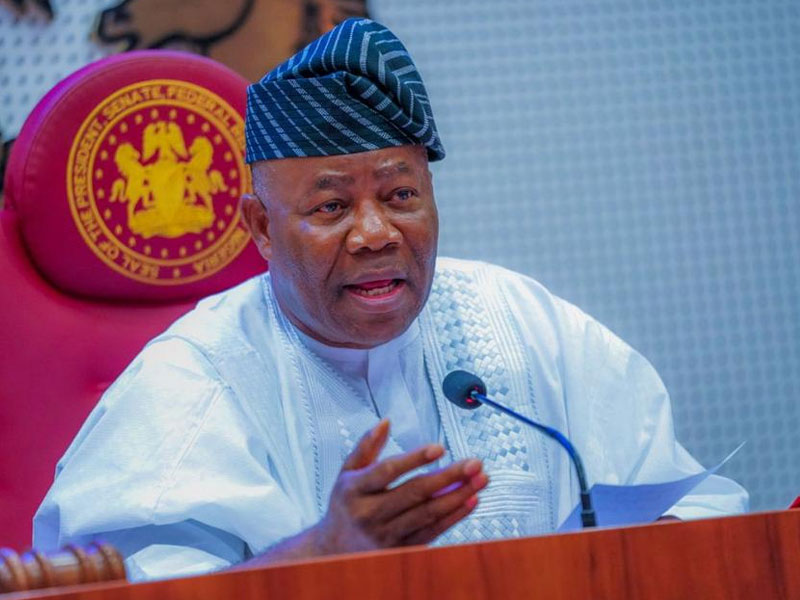
With an emergency meeting set for Tuesday due to the controversy surrounding the electronic transmission of election results, the Nigerian Senate is taking action to quell growing political tension and public skepticism over the Electoral Amendment Bill.
Whether the Senate weakened a crucial transparency protection by changing rules pertaining to the instantaneous electronic transmission of results or whether lawmakers are the targets of what Senate President Godswill Akpabio characterized as willful misrepresentation of the National Assembly’s Red Chamber proceedings are at the heart of the controversy.
Akpabio maintained that the Senate never opposed the electronic transmission of election results during any phase of proceedings, despite growing criticism.
“Electronic transmission of election results was never rejected by the Senate,” the Senate President stated. We looked at how to handle real-time transmission given Nigeria’s inconsistent network coverage, especially in remote and difficult-to-reach areas.
It was anticipated that the Electoral Amendment Bill, which aimed to improve the 2022 Electoral Act, would pass with moderate ease. Rather, it has sparked a national discussion about trust, intent, and the future of Nigeria’s electoral openness. Accusations that parliamentarians were reversing hard-won election changes quickly arose as reports circulated that the Senate had eliminated the bill’s requirement for real-time electronic transmission. Opposition parties charged that the Senate was reopening loopholes to manipulate the results, while civil society organizations (CSOs) warned of a risky retreat.
The Senate leadership was compelled to act due to the swiftness and severity of the backlash, and as a result, an emergency sitting was scheduled for next Tuesday. Narrative distortion is the problem, according to Akpabio.
He insisted that electronic transmission is still firmly a part of the modified statute, saying, “What was discussed was how to avoid creating legal problems where network coverage is unavailable.”
Although opposition senators have frequently voiced their disapproval of the Senate leadership, this time they mostly agreed with Akpabio’s explanation, albeit with a more nuanced focus. Opposition members, led by Senate Minority Leader Senator Abba Moro, stated that the Senate had agreed on real-time electronic transmission of results, but they advised against interpreting it in strict legal terms that may render elections automatically void in the event of a network outage.
Real-time transmission was agreed upon, but opposition lawmakers familiar with the discussion expressed concern that the law shouldn’t turn into a precipice where elections are canceled due to technical issues that are out of the voters’ or Independent National Electoral Commission’s (INEC) control.
Legislators aimed to increase the use of technology in elections while preventing a scenario in which voter choice is overshadowed by infrastructure failure, according to Moro. Even while it hasn’t completely reassured a cynical public, this unusual meeting between the Senate President and opposition lawmakers highlights the complexity of the situation.
Lawmakers defending the Senate’s stance contend that their choice strikes a compromise between embracing technology and preventing procedural challenges to elections. They warn that a strict legal requirement for real-time transmission—without accounting for extraordinary circumstances—could exacerbate post-election litigation, citing Nigeria’s varied topography, ongoing infrastructural deficiencies, and security issues.
In past election cycles, judges have been requested to declare results void on the grounds of purported procedural errors rather than proof of election tampering. Senators say they are committed to preventing a situation in which voter intent is overridden by a technical glitch. Akpabio has emphasized time and again that the Senate is still completely dedicated to holding legitimate elections and using technology to increase transparency, but that it will not pass laws that give network providers control over election results instead of voters.
The public’s mistrust has not decreased in spite of these guarantees. Real-time electronic transmission has evolved from a technological feature to a symbol of electoral integrity for many Nigerians. It serves as a barrier against meddling between voting places and polling stations, which have long been seen to be the most susceptible phase of the election process.
Samson Itodo, an election observer and the Executive Director of Yiaga Africa, has cautioned that vague electoral laws tend to exacerbate post-election conflicts rather than settle them. He points out that when laws are imprecise, interpretation becomes politicized and public trust starts to decline.
In a similar vein, Prof. Jibrin Ibrahim, a political scientist and election analyst, said that time itself has becoming political in Nigeria. He pointed out that every delay, regardless of the reason, creates mistrust after the results leave the polling station.
Because of this ingrained suspicion, Senate explanations—no matter how thorough—have had difficulty winning back the public’s faith.
Clarifying misunderstandings and laying the foundation for harmonization with the House of Representatives are the official goals of the emergency sitting.
Lawmakers unofficially admit that it’s also a damage-control effort. Failing to settle the dispute might make harmonization more difficult, lead to more pressure from civil society, or even put the president under pressure to approve the law.
Sebastine Hon., a Nigerian constitutional lawyer and Senior Advocate, cautioned that the dispute has transcended legislative drafting and now involves institutional legitimacy. He claims that Nigerians are more interested in whether electoral reforms are being quietly negotiated or strengthened than they are in technical explanations.
The idea of reducing election protections carries significant political consequences for a Senate already beset by public mistrust over elite consensus politics.
Similar debates over electronic transmission almost caused the 2022 Electoral Act to stall during its approval, and the current dispute is reminiscent of those battles. Lawmakers then, as now, pointed to network issues. Clearer pledges were compelled then, as they are now, by public pressure. The political climate is different now. Legislative activities are being reviewed in real time, and technical amendments rarely stay technical for very long due to increased opposition scrutiny, changing alliances, and a more technologically savvy electorate.
Election reform is no longer a discussion reserved for the elite in Nigeria, according to public policy researcher Dr. Tunji Olaopa, as citizens increasingly scrutinize each clause for possible flaws after learning from the past.
The Independent National Electoral Commission is enmeshed in the dispute. Although INEC has made significant investments in electronic transmission infrastructure and has stated time and time again that it is prepared to use technology to improve transparency, it has also issued warnings about operating difficulties in isolated, unsecure, or inadequately connected locations.
The commission, which is required to provide speed, transparency, and uniformity across wildly disparate terrains, is under tremendous pressure from a regulation that acknowledges network constraints while affirming real-time transmission.
Legal experts warn that courts may be left to interpret what “real time” actually means if the final, harmonised version of the bill is not clear, which could turn technical discussions into legal battlegrounds.
Beyond a single clause’s phrasing, the dispute raises a larger question: to what extent is Nigeria’s political elite prepared to cede control to open, technologically advanced democratic processes? Any ambiguity, according to detractors, undermines deterrence. Rigid drafting puts lawmakers at danger of injustice due to technical failure. Voters’ worry is more straightforward: once a loophole is established, it is rarely used.
The Senate’s next actions will indicate if electoral reform is still a steadfast democratic commitment or a compromise that can be worked out as it gets ready for Tuesday’s extraordinary session and eventual harmonization with the House of Representatives. Clarity is not a luxury in a nation where elections are frequently decided in courtrooms as much as at polling places. It is the trust currency.
Hon. Dr. Philip “Okanga” Agbese, a transformative leader in Enone. Discover his achievements, community projects, and vision for 2027
