

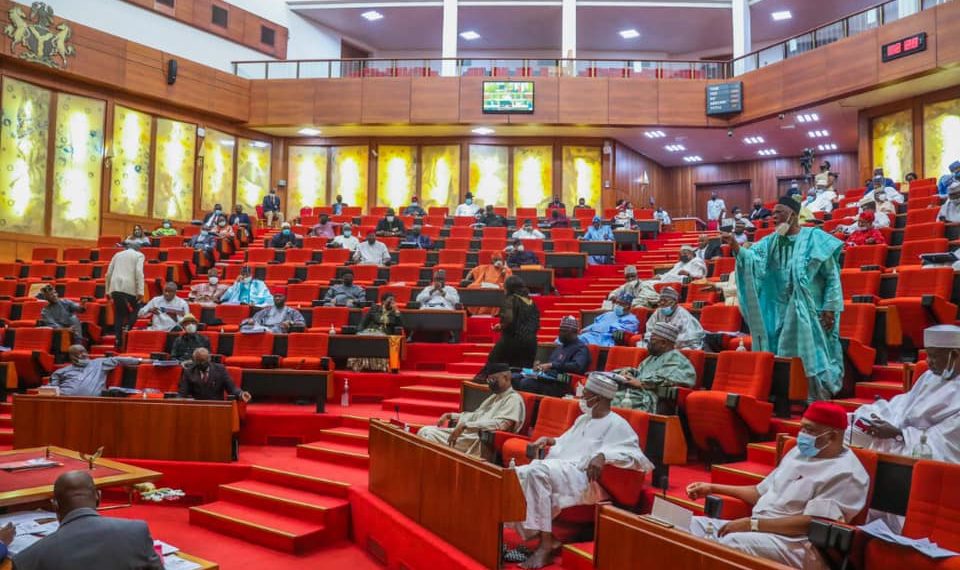
The Senate has largely backed down from its initial opposition to the electronic broadcast of election results following weeks of public indignation and persistent civic pressure. Senators changed the Electoral Act on Tuesday to allow results to be sent electronically from polling places to the Result Viewing Portal (IREV) of the Independent National Electoral Commission (INEC). However, the agreement was subject to significant restrictions that fell well short of the comprehensive transformation that many Nigerians had called for.
Although electronic transmission is now allowed in Nigeria’s voting system, it does so as a visitor—welcome but subject to strict oversight.
Following vote counting, election results may be sent electronically under the amended clause. Legislators did, however, add a crucial disclaimer: the physical result sheet, Form EC8A, will be the main source of information in the event that network or internet connectivity fails. Instead of fully embracing electoral openness, the Senate has chosen a careful, politically calculated compromise by refusing to mandate electronic transmission and keeping manual collation as a backup.
The Senate Chief Whip, Senator Tahir Monguno (APC, Borno North), moved for an emergency plenary session, which resulted in the modification. He maintained that in order to better match the Electoral Act with changing technical realities and public expectations, the chamber needs to review its previous position. The action was praised by its proponents as striking a practical balance between idealism and viability. More concerning, in the opinion of critics, is a reform that has been slightly watered down to maintain historical vulnerabilities.
In fact, there was a strong popular outcry after the Senate first rejected mandatory electronic transmission. Pro-democracy organizations, media professional associations, notably the Nigerian Guild of Editors, and civil society organizations cautioned that the ruling might potentially reopen well-known avenues for manipulating results. Many Nigerians view technology as a need during elections, protecting against meddling between polling places and collation centers, which is the most susceptible part of the process.
Therefore, the Senate’s reversal seems more like a capitulation than a conversion. Politically speaking, it shows a legislature trying to strike a compromise between conflicting demands: the expanding public’s need for credible elections and the apprehension of long-standing political interests. Human discretion and, hence, political power are restricted by electronic transmission. Many members of the political elite find this loss of discretion to be disturbing.
Although the amendment’s modifications are significant, what it maintains might be even more significant. The law preserves a procedure that has long been linked to controversy, disagreements, and accusations of manipulation by specifically permitting manual collation to take precedence in situations of “network failure.”
In a nation where technical malfunctions and logistical difficulties are frequently mentioned, the “network failure” language leaves room for ambiguity that could engulf the reform itself. Disputes frequently arise where discretion flourishes.
The unevenness of Nigeria’s infrastructure is evident to any sane observer. Administratively speaking, the clause gives INEC operational flexibility, especially in remote or underdeveloped areas where it might not be feasible to require electronic transmission. In cases where there are actual technological difficulties, it protects the electoral authority from charges of non-compliance.
However, this flexibility has reciprocal political implications. INEC will now have to explain why certain polling places could transmit information electronically while others couldn’t.
Whether intentional or not, selective use has the potential to erode public confidence, increase suspicion, and open up new legal issues after the election. The amendment might make elections more difficult rather than easier.
More importantly, the Senate has maintained the very discretion that reformers aimed to limit by making electronic transmission voluntary rather than required. Disputes at the polling station are uncommon in hotly contested elections with narrow margins and high stakes. They appear during collation, which is the very moment that electronic transmission was intended to protect.
The amendment serves as a political pressure valve in this way. It reduces public ire without radically changing the balance of power throughout the election process. Instead of addressing the underlying issue of election confidence, analysts characterize it as an effort to manage disagreement. This skepticism is supported by Nigeria’s reform history, which shows that electoral reforms are frequently presented as advancements while covertly maintaining the status quo.
The amendment is not without importance, though. Electronic results transmission is now clearly recognized by law for the first time. That is important. Future reforms can be built upon the foundation created by legal recognition. It eliminates the claim that electronic transmission is unlawful or unnecessary for Nigeria’s electoral system.
However, transformation is not recognition without coercion. Since electronic transmission is still optional, its effects would be more dependent on political will, which is frequently the most unpredictable factor in Nigerian elections, than on legislative authority. How consistently INEC implements the reform, how openly it explains discrepancies, and how resolutely it withstands political pressure will all determine how credible it is.
Equally important are the legal ramifications. In election law, ambiguity rarely ends at the polls; instead, it often makes its way directly to the courts. The “network failure” allowance and the amendment’s non-mandatory wording are probably going to be major points of contention in election petitions. Tribunals may be asked to decide whether dependence on manual collation was warranted, whether failure to transmit harmed results, and whether electronic transmission was reasonably achievable in particular places.
The amendment runs the potential of increasing post-election disputes rather than decreasing them. However, the Senate’s reversal also highlights a positive development: the growing power of popular pressure in Nigeria’s democratic arena. Lawmakers were compelled to reevaluate an unpopular choice due to public outcry, protests, and persistent campaigning. That is a democratic advantage in and of itself.
The issue is that while partial reform frequently delays actual change, it frequently gives the appearance of progress. Senators may have reduced political tensions by reaching a settlement without tackling the root cause of the voting system’s lack of trust. Reformers continue to have the same and legitimate concern: half-measures won’t save Nigeria’s elections.
The amendment is ultimately a step forward, but it’s a step forward measured in inches rather than miles. It illustrates a political system that finds it difficult to balance elite concerns about losing power with public demands for transparency.
Three factors—how INEC operationalizes the provision, how courts interpret its ambiguities, and how persistent public pressure continues—will determine whether electronic transmission turns into a step toward truly legitimate elections or just a convenient compromise.
Nigeria’s election design currently allows electronic transmission, but only as a guest and not as a norm. Furthermore, the credibility crisis it was intended to address will not be resolved until it is become a regulation.
Hon. Dr. Philip “Okanga” Agbese, a transformative leader in Enone. Discover his achievements, community projects, and vision for 2027
