

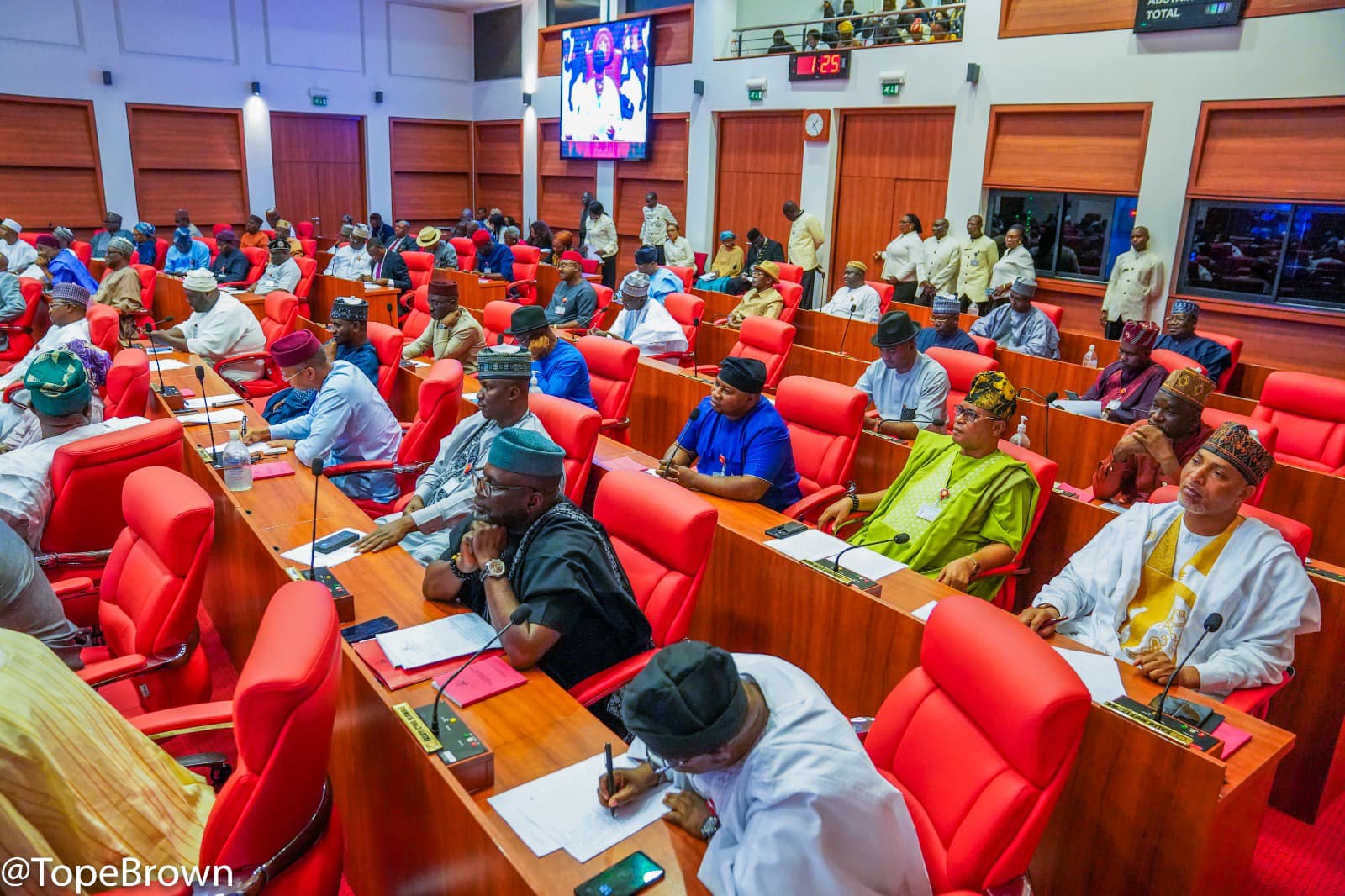
The Investments and Securities Tribunal’s (IST) management came under fire from the Senate on Tuesday for spending N16 million on office cleaning and fumigation in 2025, calling the expenditure dubious during a period of severe economic hardship.
Lawmakers voiced concerns about what they saw as misaligned objectives in the agency’s spending profile during the tribunal’s defense of its 2026 budget before the Senate Committee on Capital Market.
Capital market disputes are decided by the IST, a specialized fast-track civil court created by the Investments and Securities Act of 2007 and most recently revised in 2025. Appeals are heard by the Court of Appeal.
Senator Osita Izunaso (APC, Imo West), the committee’s chairman, led the interrogation and demanded explanations for the N16 million spent on cleaning and fumigation out of the N30 million allocated for the item in the 2025 budget.
Izunaso questioned why, despite the tribunal’s operations being little known to investors and market participants, such a large sum was allocated to cleaning services when crucial aspects like public awareness and outreach were underfunded.
Aminu Junaidu, the tribunal’s chairman, defended the expense by stating that fumigation is done every three months to protect confidential documents from rodents and other pests.
He further mentioned that some of the expense was incurred since cleaning services were contracted out to the regional offices of the tribunal.
“We have to keep our records safe. It is imperative that we preserve our confidential documents. He informed the committee that fumigation is carried out on a regular basis for this reason.
Lawmakers insisted, however, that agencies must exercise caution and match spending to public expectations during a time of financial restraint.
The committee also criticized the tribunal for continuing to rely on consumables and stationery in spite of growing calls for government functions to be digitalized.
Nasarawa South Senator Ogoshi Onawo criticized what he called exorbitant office supply spending and urged the tribunal to adopt digital procedures in order to reduce expenses.
The committee was given a 2025 budget performance report, which showed that the IST had spent N6.134 million on computer consumables and office supplies.
The tribunal’s work necessitates a great deal of documentation, including the authoring of rulings and judgments and the creation of Certified True Copies (CTCs) for plaintiffs and other applicants, according to Junaidu’s response.
It’s a tribunal. Our decisions and judgments have to be in writing. We provide litigants with photocopies. We have to give it to the person who applies for a CTC. We consume a lot because of this,” he said.
Although petitioners pay for certified copies, Junaidu explained that the tribunal does not receive the money collected since the fees—roughly N10 per page—are sent straight to the Federal Government’s Treasury Single Account (TSA).
“We have no control over the money; it goes directly to the TSA,” he continued.
The tribunal’s 2025 spending profile showed considerable expenditures in areas other than cleaning and stationery. In addition to N64 million for other local travel and transportation-related expenses, it spent N29 million on training, transportation, and local travel.
Utility costs also took center stage. Telephone charges totaled N990 million, while electricity expenses came to N981 million. The cost of internet connectivity was N702 million.
Additionally, N3.4 million was spent on maintaining motor vehicles and transport equipment, N9.5 million was spent on local training, and N39 million was spent on fuel for plants and generators.
Lawmakers expressed plans to examine the agency’s spending habit in greater detail after the statistics caused a stir in the committee chamber.
The Senate panel emphasized that the IST, a crucial organization in Nigeria’s capital market dispute resolution system, must operate with fiscal restraint in addition to providing justice effectively.
Lawmakers cautioned that public institutions must justify every kobo spent and show value for money in budget implementation, as many Nigerians are confronting increased living expenses.
It is anticipated that the committee will keep reviewing the tribunal’s financial records as part of its larger investigation into the budget projections for capital market authorities in 2026.
Hon. Dr. Philip “Okanga” Agbese, a transformative leader in Enone. Discover his achievements, community projects, and vision for 2027
